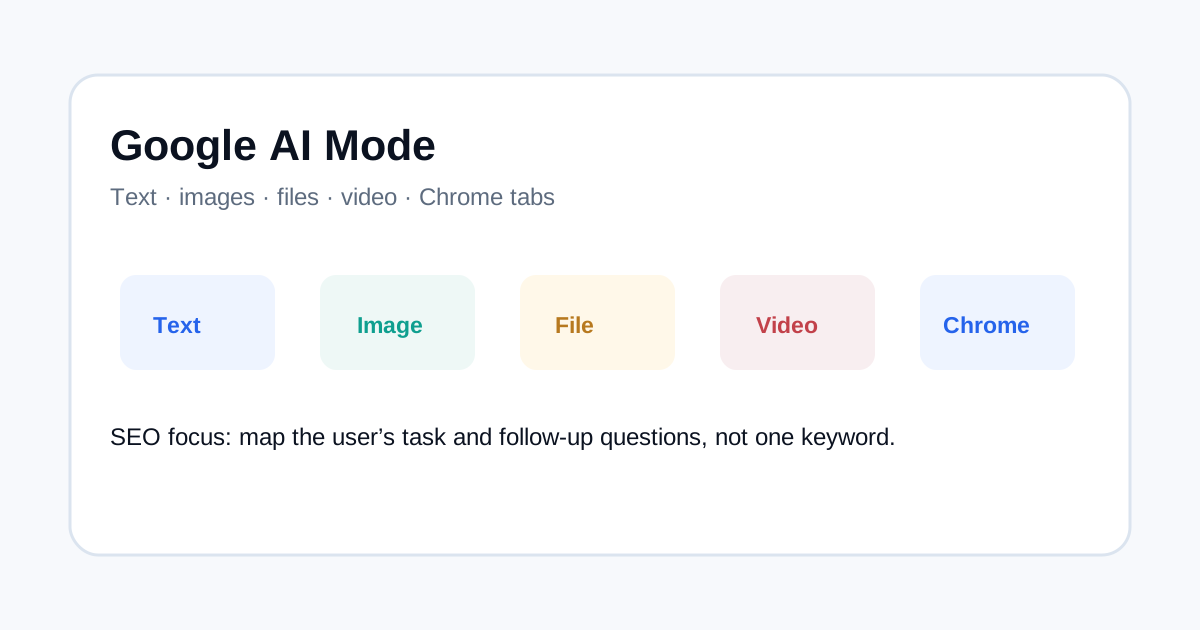
Google has expanded AI Mode so people can ask questions using more than a short text query. Google says its Search experience can work across text, images, files, videos and Chrome tabs, while AI Mode can break a question into subtopics and search for relevant information. For SEO teams, the change is mainly about understanding richer intent rather than chasing a new secret ranking factor.
What changed in AI Mode
Google says AI Mode is designed for deeper questions and follow-up exploration. Its documentation says the system can divide a question into subtopics and search for each one. The Search updates announced at I/O 2026 also described inputs that go beyond typed keywords.
Why multimodal inputs change SEO research
Traditional keyword research often starts with text queries. A multimodal workflow can begin with an image, document or page and then turn into several related questions. That makes intent mapping more important than building a page around one exact phrase.
Map the task, not only the keyword
For a page to be useful in this environment, map the complete task a person is trying to finish. Identify the information they need before the decision, the comparisons they may make, the proof they need and the next action after reading.
| Intent layer | SEO question |
|---|---|
| Understand | What facts must the page explain? |
| Compare | Which options need a clear difference table? |
| Verify | Which claims need primary sources? |
| Act | What should the reader do next? |
Build pages that answer follow-up questions
AI-assisted search can create a sequence of related questions. A strong page should therefore explain the main topic clearly, answer natural follow-ups and link to deeper resources where needed. ToolBoxKart already uses this approach in its longer-query SEO workflow and zero-click search strategy.
Use source quality as part of content planning
Google’s Search documentation says AI Mode relies on web information and can provide links to useful sources. That is another reason to support important claims with clear evidence. Do not treat a model summary as proof. Link readers to the source that supports a material statement.
What not to do
Do not create separate thin pages for every possible phrasing of an AI query. Do not stuff long lists of related terms into headings. Do not assume that adding the words “AI Mode” to a page creates a ranking advantage. The goal is a page that is complete, useful and easy to verify.
FAQ
Does AI Mode remove normal search results?
No. Google says users can still get web links and a range of Search results while using the AI experience.
Should every page target multimodal search?
No. Focus on the formats and questions that match the real task and audience for the page.
Sources
- Google — Google Search’s I/O 2026 updates
- Google Search Help — Get AI-powered responses with AI Mode in Google Search