Google Cloud has made its U4 machine family generally available as part of its Ultra Low Latency solution. Google announced the U4 family on October 7, 2026 for high-frequency trading workloads, where network delay and predictable performance can matter as much as raw compute. The same infrastructure direction is relevant to AI teams because modern AI systems increasingly depend on fast movement between models, data, tools and services.
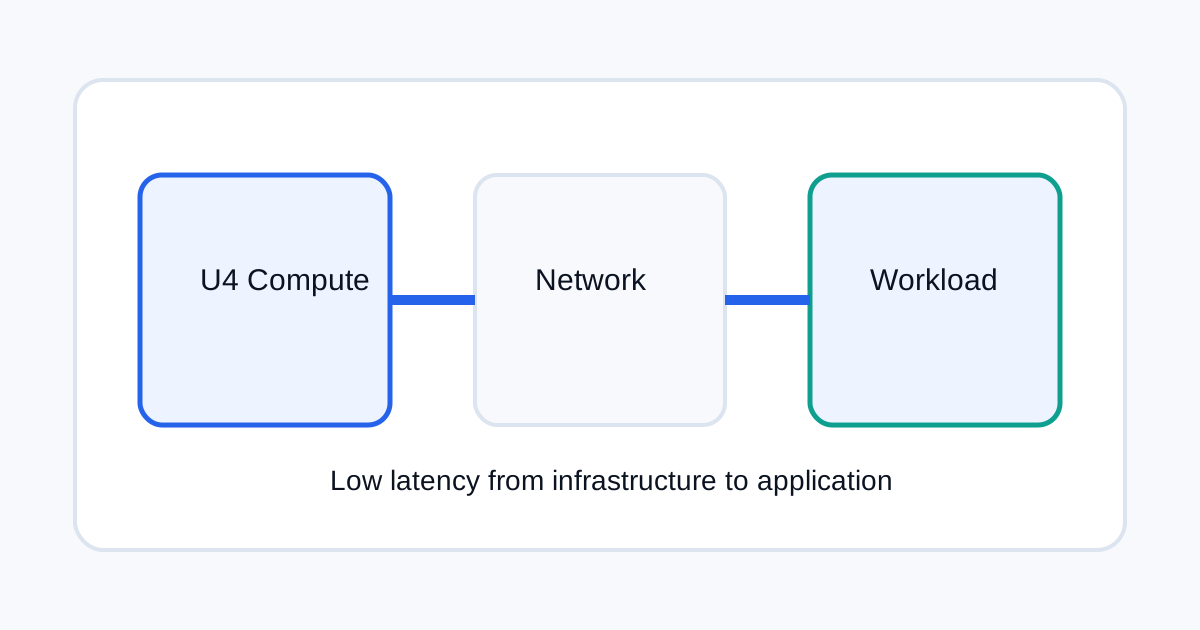
What Google Cloud changed
Google Cloud says the Ultra Low Latency solution is now generally available and includes the U4 machine family. The design targets capital-markets workloads that need predictable network behavior and fast access to colocated systems.
This is not an AI model launch. It is an infrastructure update. That distinction matters because infrastructure changes can affect the economics and responsiveness of AI applications without changing the model itself.
Why latency matters for AI systems
AI workloads are often discussed in terms of tokens per second, but an application can spend significant time waiting on other parts of the system. Database calls, tool calls, network transfers, queueing and service-to-service communication can all add delay.
For an agent that makes several calls in sequence, small delays can add up. Lower network latency can therefore help workloads where the model is only one part of the end-to-end response time.
What U4 is actually designed for
Google Cloud's announcement focuses on high-frequency trading and its Ultra Low Latency solution. It describes predictable performance, low-latency networking and cloud-based agility as alternatives to some traditional on-premises constraints.
That does not mean U4 is automatically the right choice for AI inference. Workloads should be tested against the full system, including model hosting, storage, network path and application architecture.
Where this infrastructure can matter to AI teams
- Real-time systems that call several services in sequence.
- AI applications that combine models with low-latency data stores.
- Agent workflows where tool calls are a large part of total response time.
- Data pipelines that need predictable network performance around inference or decision systems.
For many ordinary AI applications, a standard cloud setup may be more than enough. The value of low-latency infrastructure becomes clearer when latency is measurable and directly affects the business outcome.
How to test whether low latency is worth the cost
- Measure end-to-end response time before changing infrastructure.
- Break the measurement into model, network, storage and tool-call time.
- Identify the slowest repeated step.
- Test the same workload on the candidate infrastructure.
- Compare the latency improvement with the added infrastructure cost and operational complexity.
This approach avoids the common mistake of buying faster infrastructure when the real bottleneck is a slow database query or an inefficient agent loop.
What remains unknown
Google's U4 announcement is focused on capital-markets infrastructure, so AI teams should not assume that every U4 performance characteristic transfers directly to model-serving workloads. Capacity, region, supported configurations and pricing should be checked for the exact workload.