You’re Probably Using Schema for the Wrong Goal
Most SEOs implement schema markup, run it through Google’s Rich Results Test, see a green checkmark, and move on. That approach made sense in 2021. In 2026, it misses the actual game entirely.
Schema markup is no longer primarily about getting star ratings or breadcrumbs in search results. It is now a core input layer for Google’s AI Overviews, AI Mode, and answer engine citations. If you built your schema strategy around rich results, you built it for the wrong surface.
Before going further, three confusions need to be resolved — because they shape every implementation decision in this guide.
Confusion 1: What “AEO” Actually Means
Answer Engine Optimization (AEO) gets used three different ways across the SEO industry. Some practitioners use it to mean featured snippet optimization (an old frame from 2019). Others use it to mean voice search optimization (also outdated). A third group — the correct one in 2026 — uses it to mean optimizing your content and structured data to appear as cited sources inside AI-generated answers from Google, Bing Copilot, Perplexity, and ChatGPT Search.
Confusion 2: Schema Markup vs Structured Data vs JSON-LD
These three terms get used as synonyms. They are not.
Schema markup is the vocabulary — the defined set of types and properties maintained at schema.org. Structured data is the broader practice of embedding machine-readable information into web pages. JSON-LD is a specific format for writing that data. There are three formats in existence: JSON-LD, Microdata, and RDFa. Google recommends JSON-LD for all new implementations.
Confusion 3: Rich Results vs AEO Signals
This is the most dangerous conflation. Schema that generates rich results — star ratings, FAQ dropdowns, breadcrumbs in the SERP — is not the same as schema that influences AI Overview citations.
Product schema can earn you a rich result. It will not automatically get you cited in an AI-generated answer. The schema types and properties that drive AEO citations are different, and most guides never explain which is which.
That is what this playbook does.
What Is Schema Markup, Structured Data, and JSON-LD? (And How They Differ)
Schema.org — The Vocabulary
Schema.org is a shared vocabulary created in 2011 by Google, Microsoft, Yahoo, and Yandex. It defines every type of entity a web page can describe — an Article, a Product, a Person, an Event, an Organization — and every property those entities can carry. Think of it as a dictionary that search engines and AI systems agree to read.
The vocabulary is publicly maintained at schema.org and receives regular updates. New types appear as search behavior evolves. The addition of ProfilePage, SpeakableSpecification, and DefinedTerm in recent years reflects how AI-driven search changed the priority landscape.
Structured Data — The Practice
Structured data is the act of embedding machine-readable information in your web pages. It is not a format. It is not a vocabulary. It is the broader discipline of making content interpretable by machines without requiring them to parse your prose.
A page can have rich, readable content and poor structured data. A page can also have complete structured data and thin content. For AEO, you need both working together.
JSON-LD — The Format Google Recommends
JSON-LD (JavaScript Object Notation for Linked Data) is the implementation format Google recommends for all structured data. It sits in a <script> tag in your page’s <head> or <body>. It does not interrupt your HTML.
Microdata and RDFa still exist. Google does not support Microdata for many newer schema types. Do not waste implementation time on either format. Use JSON-LD for every new schema build.
Why This Distinction Matters for AEO
AEO citation happens at the entity level, not the format level. Google does not cite your page because you used JSON-LD correctly. It cites your page because the entities described in your structured data align with its Knowledge Graph and match the information need in an AI query.
Format is the vehicle. Entity clarity is the destination.
Read Also: Top 10 AEO Tools for SEO Automation in 2026
How Google Uses Schema to Build AI Answers
From Schema to Knowledge Graph — The Entity Reconciliation Path
Google’s Knowledge Graph stores facts about real-world entities — people, organizations, places, concepts. When your schema markup describes an entity clearly and consistently, Google can reconcile your page’s data with existing Knowledge Graph entries.
This is entity reconciliation. It is the mechanism that connects your structured data to AI answer construction.
For example, if your Organization schema includes a sameAs property pointing to your Wikidata entry and your Wikipedia page, Google can match your site’s entity to a verified record in its Knowledge Graph. That connection makes your content more likely to be pulled into AI-generated answers when a relevant query fires.
How AI Overviews Pull from Structured Data
Google’s AI Overviews (launched May 2024, according to Google’s Search Central blog) do not simply lift text from pages. They synthesize information from sources Google has assessed as authoritative, accurate, and well-structured.
Schema markup contributes to that assessment in two ways. First, it helps Google understand what your page is about without relying purely on natural language parsing. Second, it signals entity relationships — author, publisher, subject matter — that feed Google’s trust evaluation.
Pages with coherent, layered schema tend to appear in AI Overviews more consistently than pages with no structured data or broken schema. This is not a guarantee. It is a consistent pattern.
Schema vs Content Quality — Which Matters More?
Schema without content quality does nothing. Content quality without schema leaves signals on the table.
The correct frame is that schema amplifies what your content already communicates. A well-researched, accurate article with complete Author, Organization, and Article schema gives Google more to work with than the same article with no structured data. The content has to earn the citation. The schema helps Google understand who is making the claim, from what source, and in what context.
For AEO, both matter. You cannot shortcut either.
The Validation vs Activation Gap (Why Your Schema Might Be Doing Nothing)
This is the most underreported failure mode in schema implementation. Schema can pass every validation test — no errors, no warnings, clean output in the Rich Results Test — and still produce zero AEO benefit.
Validation means your JSON-LD is syntactically correct. Activation means Google has connected your entities to its Knowledge Graph and incorporated your structured data into its answer construction process.
The gap between them exists because activation depends on factors beyond syntax: entity authority, content quality, topical consistency, and the strength of your sameAs references. A site with no established entity presence can implement perfect schema and remain invisible in AI Overviews.
Knowing this changes your implementation priorities. Get your entities established first. Then layer in your schema.
The AEO Schema Stack — Which Types Actually Matter
Tier 1 — Foundational Schema (Every Site Needs These)
These three schema types belong on every site, on every page, regardless of content type or industry. They build the structural base that all other schema types rely on.
WebSite and WebPage Schema
WebSite schema goes on your homepage. It defines your site as a named entity with a URL. Include a SearchAction property if your site has internal search — Google uses this for sitelinks search boxes in traditional results and as a structured signal in AI answer construction.
WebPage schema goes on individual pages. It names the page, identifies the author, and connects the page to the broader WebSite entity. Without it, each page exists as an isolated document rather than a node in an interconnected content graph.
Organization Schema (with sameAs for Entity Authority)
Organization schema is your brand’s identity layer. It tells Google the name of your organization, your logo, your contact information, and — most importantly — your entity references via sameAs.
The sameAs property is where most sites leave value behind. Point it to your Wikidata entry, your Wikipedia page, your LinkedIn company page, your Crunchbase profile, and any other authoritative third-party source that describes your organization. This is the primary mechanism for Knowledge Graph reconciliation.
BreadcrumbList Schema
BreadcrumbList schema communicates your site’s structure to Google. It shows how a page fits within a content hierarchy. For AEO, it matters because AI answer construction favors content from sites with clear, logical architecture.
Implement it on every page except the homepage. Match the breadcrumb values exactly to your visual breadcrumbs on the page.
Tier 2 — Content-Type Schema (Match to Your Page Format)
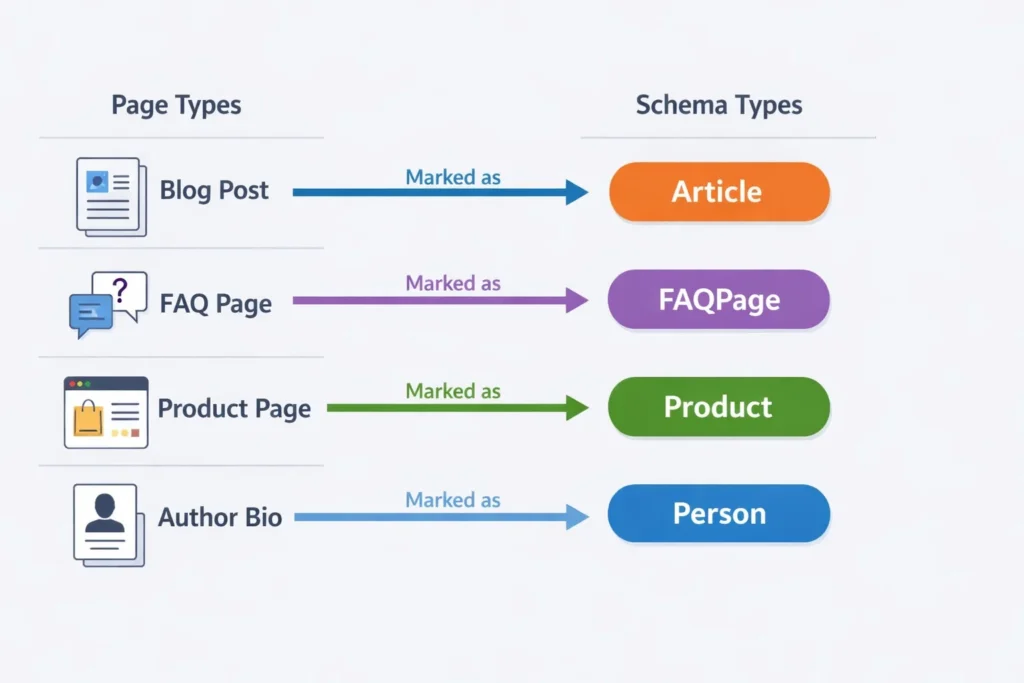
These schema types map to specific page formats. Do not apply them generically across your site. Apply them only to pages where the content type genuinely matches the schema definition.
Article and TechArticle Schema
Article schema applies to editorial content: news, blog posts, opinion pieces, analyses. TechArticle is the more specific type for technical guides, documentation, and how-to content aimed at a technical audience.
For AEO purposes, TechArticle is the stronger signal for technical content. It communicates subject-matter specificity that Article does not. Include author, publisher, datePublished, dateModified, and headline at minimum. The author property should reference a Person entity, not just a plain text string.
FAQPage Schema (What Changed and What Still Works)
A persistent myth has circulated since 2023 that Google removed FAQ schema. That is not accurate.
What Google changed was the default rich result display for FAQ schema. In late 2023, Google reduced how frequently FAQ dropdowns appear in standard search results, according to Google’s structured data documentation. The schema type itself still functions. Google still reads it. And for AEO, FAQPage schema remains one of the most effective types for surfacing content in AI-generated answers, because it directly maps question-and-answer pairs — exactly the format AI Overviews draw from.
Use FAQPage schema on any page that contains genuine question-and-answer content. Do not fabricate Q&A pairs just to use this schema type — that falls under structured data spam.
HowTo Schema (Current Status and Best Use)
HowTo schema had its desktop rich result display reduced in late 2023. Mobile display was not equally affected. For AEO, HowTo schema still contributes meaningful signals because it structures step-based content in a format AI answer engines can parse and cite directly.
Use HowTo schema on pages where the content is a genuine sequential process. Include each step with its own name, text, and where relevant, an image. The schema has to match the visible page content exactly.
ItemList Schema for Listicles
ItemList schema applies to roundup articles, ranked lists, and any content structured as a series of named items. It is underused relative to its AEO value.
AI Overviews frequently pull ranked or categorized lists. ItemList schema tells Google that your page contains a structured list, what each item is, and what order they appear in. For list-format content, this is a higher-priority schema type than most SEOs realize.
Tier 3 — AEO-Amplification Schema (Underused, High-Impact)
These schema types do not appear in most implementation guides. They carry some of the highest AEO signal value available, which is why leaving them out is a competitive advantage for anyone willing to implement them.
Speakable and SpeakableSpecification Schema
Speakable schema marks specific sections of your page as optimized for audio playback and voice-based answers. It is still listed as experimental in Google’s documentation, but its relevance to AEO is growing as voice-driven AI interfaces expand.
SpeakableSpecification defines which content sections carry Speakable markup. Use it on your most concise, definitive answer passages — the sentences that directly answer a question in plain language. These are exactly the passages AI answer engines prefer to cite.
DefinedTerm Schema for Topical Authority
DefinedTerm schema marks up glossary entries and concept definitions. It is emerging as a topical authority signal — it tells Google that your site explicitly defines the vocabulary of a subject area, not just discusses it.
For sites building authority in a specific niche, a glossary section with DefinedTerm schema is a structural investment in entity recognition. It connects your site’s content to the conceptual vocabulary Google uses to classify knowledge.
Person and ProfilePage Schema (Author Entity Authority)
Person schema creates an entity record for individual authors. ProfilePage schema (a newer type introduced in recent Google structured data revisions) marks up author bio pages specifically.
For AEO and E-E-A-T, author entity schema is one of the highest-leverage implementations available. When Google can confirm that a named human with verifiable credentials wrote a piece of content, that content becomes a stronger candidate for AI Overview citation. Link your Person schema to the author’s professional profiles via sameAs.
ClaimReview Schema for Trust Signals
ClaimReview schema marks up fact-checking content. It tells Google that a page has reviewed a specific claim, assessed it, and reached a conclusion.
For sites in health, finance, news, or any domain where accuracy is high-stakes, ClaimReview schema contributes directly to trust signals. Google uses it to identify pages that actively engage with accuracy — a strong positive signal in an E-E-A-T evaluation.
Tier 4 — Vertical Schema (Industry-Specific)
These types apply to specific industries and page types. Implement the ones that match your content. Do not apply vertical schema to pages where the content does not genuinely fit the type.
Product + Review Schema
Product schema applies to individual product pages. Pair it with Review or AggregateRating schema to enable star ratings in traditional search results. In 2026, Google also uses Product schema for Merchant Center integration and product freshness signals — include offers with current pricing and availability data.
Event Schema
Event schema applies to any page describing a scheduled occurrence — conferences, webinars, concerts, meetups. It requires a startDate, location, and name at minimum. For recurring events, each instance should carry its own Event markup.
Recipe Schema
Recipe schema is one of the most mature and fully-supported schema types in Google’s ecosystem. It unlocks rich results in Google Recipe search and contributes to AI answer construction for cooking queries. Include ingredients, steps, timing, and nutritional data for full activation.
LocalBusiness Schema
LocalBusiness schema applies to any business with a physical location and a geographic service area. It is a foundational type for local SEO and feeds directly into Google Business Profile data. Include address, telephone, openingHours, and geo coordinates.
JSON-LD Implementation by Page Type
Blog Post / Article Page Schema Setup
A blog post needs a layered schema stack, not a single type. The core stack is Article (or TechArticle) + Person (author) + Organization (publisher) + BreadcrumbList.
{
  "@context": "https://schema.org",
  "@type": "TechArticle",
  "headline": "Your Article Title Here",
  "author": {
    "@type": "Person",
    "name": "Author Name",
    "url": "https://yoursite.com/author/authorname",
    "sameAs": [
      "https://www.linkedin.com/in/authorname",
      "https://twitter.com/authorname"
    ]
  },
  "publisher": {
    "@type": "Organization",
    "name": "Your Site Name",
    "logo": {
      "@type": "ImageObject",
      "url": "https://yoursite.com/logo.png"
    },
    "sameAs": [
      "https://www.wikidata.org/wiki/YOUR_ENTITY",
      "https://www.linkedin.com/company/yoursite"
    ]
  },
  "datePublished": "2026-01-15",
  "dateModified": "2026-06-10",
  "description": "A concise description of the article.",
  "mainEntityOfPage": {
    "@type": "WebPage",
    "@id": "https://yoursite.com/your-article-url"
  }
}
Validate every implementation using Google’s Rich Results Test before publishing.
FAQ Page Schema Setup
FAQPage schema requires each question-answer pair to be present verbatim on the visible page. Do not add questions that do not appear in your content.
{
  "@context": "https://schema.org",
  "@type": "FAQPage",
  "mainEntity": [
    {
      "@type": "Question",
      "name": "What is schema markup?",
      "acceptedAnswer": {
        "@type": "Answer",
        "text": "Schema markup is a structured vocabulary from schema.org that tells search engines and AI systems what your content means, not just what it says."
      }
    },
    {
      "@type": "Question",
      "name": "Does schema markup improve rankings?",
      "acceptedAnswer": {
        "@type": "Answer",
        "text": "Schema markup does not directly improve rankings. It improves how search engines understand and surface your content, which can indirectly influence visibility in AI-generated answers and rich results."
      }
    }
  ]
}
Keep answer text direct and complete. AI Overviews prefer answers that stand alone without requiring the reader to navigate the page for context.
Product Page Schema Setup
Product pages carry the most complex schema stacks. Include the product entity, its offer details, and any aggregate ratings from genuine user reviews.
{
  "@context": "https://schema.org",
  "@type": "Product",
  "name": "Product Name",
  "description": "Brief product description.",
  "image": "https://yoursite.com/product-image.jpg",
  "brand": {
    "@type": "Brand",
    "name": "Brand Name"
  },
  "offers": {
    "@type": "Offer",
    "url": "https://yoursite.com/product-url",
    "priceCurrency": "USD",
    "price": "49.00",
    "availability": "https://schema.org/InStock",
    "priceValidUntil": "2026-12-31"
  },
  "aggregateRating": {
    "@type": "AggregateRating",
    "ratingValue": "4.6",
    "reviewCount": "182"
  }
}
Keep priceValidUntil current. Outdated pricing data in schema is a quality signal violation and can suppress rich results.
Homepage and About Page Schema Setup
Your homepage needs WebSite schema and Organization schema. The About page should carry Organization schema with full sameAs references and optionally a WebPage type.
{
  "@context": "https://schema.org",
  "@graph": [
    {
      "@type": "WebSite",
      "@id": "https://yoursite.com/#website",
      "url": "https://yoursite.com",
      "name": "Your Site Name",
      "publisher": {"@id": "https://yoursite.com/#organization"}
    },
    {
      "@type": "Organization",
      "@id": "https://yoursite.com/#organization",
      "name": "Your Organization Name",
      "url": "https://yoursite.com",
      "logo": {
        "@type": "ImageObject",
        "url": "https://yoursite.com/logo.png"
      },
      "sameAs": [
        "https://www.wikidata.org/wiki/YOUR_ENTITY",
        "https://en.wikipedia.org/wiki/Your_Organization",
        "https://www.linkedin.com/company/yourorg",
        "https://twitter.com/yourorg"
      ]
    }
  ]
}
The @graph array allows you to define multiple interconnected entities in a single JSON-LD block. Use it on pages where two or more entity types are genuinely present.
Author Bio Page Schema Setup
Author bio pages are one of the most underused AEO assets on most sites. A bio page with Person schema and ProfilePage schema creates a verifiable entity record that strengthens every piece of content that author wrote.
{
  "@context": "https://schema.org",
  "@type": "ProfilePage",
  "mainEntity": {
    "@type": "Person",
    "name": "Author Full Name",
    "jobTitle": "Senior Technical Writer",
    "url": "https://yoursite.com/author/authorname",
    "image": "https://yoursite.com/author/authorname-photo.jpg",
    "sameAs": [
      "https://www.linkedin.com/in/authorname",
      "https://twitter.com/authorname",
      "https://orcid.org/AUTHOR-ORCID-IF-APPLICABLE"
    ],
    "worksFor": {
      "@type": "Organization",
      "name": "Your Organization Name",
      "@id": "https://yoursite.com/#organization"
    }
  }
}
Link the Person’s worksFor to the Organization entity defined in your homepage schema using the same @id. This cross-entity linking is what activates Knowledge Graph reconciliation at the author level.
The sameAs Property — Your Entity Authority Multiplier
What sameAs Does for Knowledge Graph Recognition
Every entity in Google’s Knowledge Graph has an identifier. When you add a sameAs property to your schema and point it to an authoritative third-party source — a Wikidata entry, a Wikipedia article, a LinkedIn page — you give Google a bridge between your site’s entity and a record it already trusts.
This is entity reconciliation in practice. It moves your organization or author from “unverified entity” to “confirmed match with known record.” That status change directly improves the probability that Google surfaces your content in AI-generated answers when that entity is relevant.
Without sameAs, your schema describes an entity in isolation. With sameAs, it joins a network of verified knowledge.
Which URLs to Include in sameAs
Not all third-party URLs carry equal weight for entity reconciliation. Rank them in this order:
Wikidata entries carry the strongest reconciliation signal. Google’s Knowledge Graph has deep integration with Wikidata. If your organization or a key author has a Wikidata entry, that URL belongs in every sameAs array they appear in.
Wikipedia URLs come second. Not every entity has a Wikipedia page, but if one exists, include it.
LinkedIn company or profile pages come third. Google indexes LinkedIn consistently and uses it as an entity verification source.
Official government databases, ISBN registries, ORCID IDs for researchers, and Crunchbase profiles all contribute meaningful signals depending on your industry.
Social media profiles (Twitter/X, YouTube, Instagram) carry the least reconciliation weight but are still worth including for completeness.
How to Set Up sameAs for Your Brand and Authors
Start at Wikidata.org. Search for your organization or key authors. If a record exists, copy the entity URL (formatted as https://www.wikidata.org/wiki/Q[number]). If no record exists, consider creating one — the barrier is low, and the entity authority benefit is significant.
Repeat the process for Wikipedia. Then compile LinkedIn, Crunchbase, and other relevant profiles. Add the complete set to your Organization schema on the homepage and to every Person schema on author bio pages.
Update sameAs references whenever a new authoritative listing becomes available. Entity reconciliation is not a one-time setup.
Read Also: How to Rank in Google AI Overviews in 2026: A Practical Framework
How to Audit Your Schema Markup
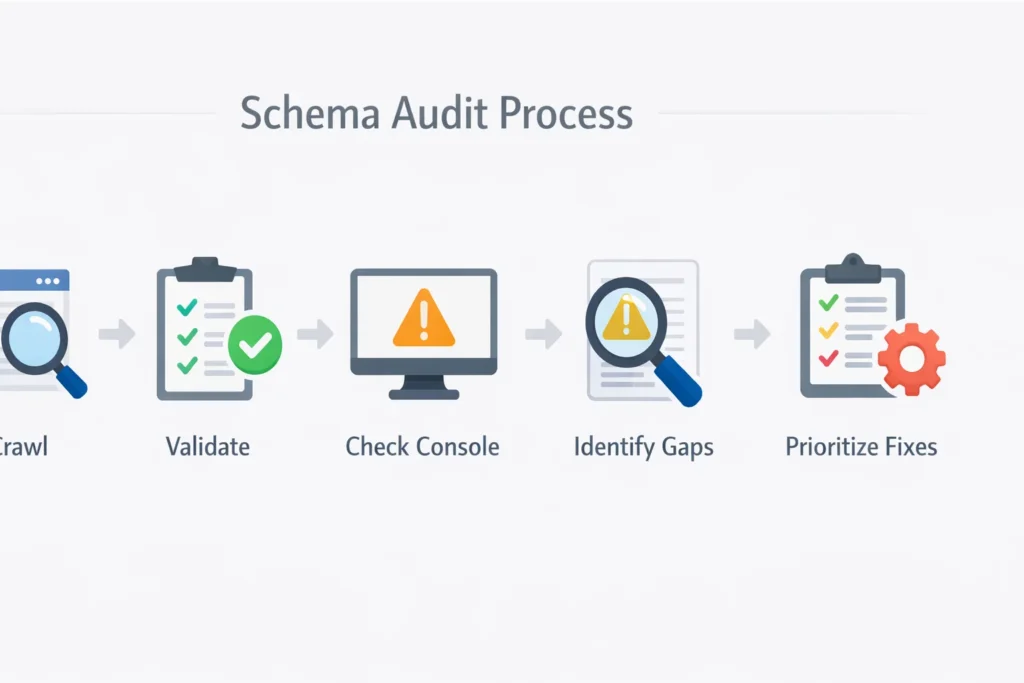
Step 1 — Crawl and Inventory Your Existing Schema
Use Screaming Frog SEO Spider to crawl your site with the “Extract” feature enabled for structured data. Set a custom extraction to capture all JSON-LD blocks across your site. Export the results to a spreadsheet.
Your goal at this step is a complete map: which pages have schema, which schema types appear, and which pages have none. Sort by page type — blog posts, product pages, the homepage, author bio pages — to identify structural gaps.
Step 2 — Validate with Google’s Rich Results Test
Take a representative URL from each page type and run it through Google’s Rich Results Test. The tool shows detected schema types, any errors or warnings, and a preview of how the schema might appear in rich results.
Errors (red) break schema function entirely. Warnings (yellow) reduce schema effectiveness but do not disable it. Address errors first. Then work through warnings by priority.
Step 3 — Check Search Console for Schema Errors
Google Search Console’s Enhancements section reports schema errors at scale across your entire site. Navigate to any schema type listed there — FAQPage, Article, Product — to see a tally of valid items, items with warnings, and items with errors.
This view shows you aggregate schema health, not just individual page validation. A single template error can propagate across thousands of pages. Identify those template-level failures first.
Step 4 — Identify the Validation vs Activation Gap
Validation passes do not confirm activation. After confirming your schema validates correctly, check whether pages with complete schema appear in AI Overviews for relevant queries.
Search manually for queries where your content is a strong match. Observe whether your site is cited. If validated pages consistently fail to appear in AI-generated answers, the issue is entity authority, not syntax.
Check your sameAs references. Verify that your Organization and Person entities have established Wikidata or Wikipedia records. Assess whether your content quality matches the specificity of the queries you’re targeting.
Step 5 — Prioritize What to Fix First
Fix errors before warnings. Fix high-traffic pages before low-traffic pages. Fix foundational schema (Organization, WebSite, WebPage) before content-type schema.
After errors are cleared, prioritize adding missing Tier 1 schema to pages that have none. Then layer in Tier 2 schema matched to page format. Address Tier 3 schema after your foundational layer is stable across the site.
If your site serves content across multiple topics or industries, run the readability and structural audit tools at ToolboxKart’s readability checker alongside your schema audit. Pages that are structurally weak in both readability and schema carry compounding disadvantages in AEO citation probability.
Schema Markup Mistakes That Hurt AEO Performance
Marking Up Content That Isn’t on the Page
Google’s structured data quality guidelines are explicit: schema markup must describe content that is visible to users on the page. Marking up an aggregate rating that doesn’t appear in the page’s visible text, or adding FAQPage schema for questions that exist only in the JSON-LD, violates Google’s spam policies for structured data.
The consequence is schema suppression. Google can ignore your structured data entirely for a page that misuses schema types. Repeated violations across a site can result in a manual action.
Using Deprecated or Misapplied Schema Types
Some schema types that appeared in guides three years ago have since changed in status or application. HowTo and FAQ schema changed display behavior in 2023. Some DataFeed and SoftwareApplication schema properties have changed requirements.
Before implementing any schema type, verify its current status at schema.org and cross-reference with Google’s structured data documentation. Do not rely on implementation guides that predate 2024 for syntax or property lists.
Ignoring the Author and Organization Entity Layer
Most sites implement Article schema and stop there. The Author property gets filled with a plain text string: "author": "Jane Smith". That is not an entity. It is a label.
For AEO purposes, author schema without a Person entity reference — with a URL, a sameAs array, and a worksFor connection to a verified Organization — contributes almost nothing to trust signal construction. Build your entity layer first, then reference it from your content schema.
Forgetting sameAs and Entity Reconciliation
Implementing Organization or Person schema without sameAs is like introducing yourself without a last name. The entity exists in your schema but cannot be connected to any external record Google already recognizes.
This is the most common high-impact mistake in schema implementation. The fix takes minutes per entity. The impact on AEO citation probability is significant.
Treating Schema as Set-and-Forget
Schema markup needs maintenance. Content changes, author information changes, product pricing changes, organization details change. Schema that was accurate at implementation becomes inaccurate over time.
Set a quarterly review on your schema audit. Run your highest-traffic pages through the Rich Results Test. Check Search Console’s Enhancements section for new errors. Update dateModified on Article schema when you update content.
Schema that reflects the current state of your page signals ongoing accuracy to Google. Outdated schema signals the opposite.
Schema for AI Mode, Perplexity, and Beyond-Google AEO
Does Schema Work in Non-Google Answer Engines?
Yes, but not uniformly. Perplexity, ChatGPT Search, and Bing Copilot all read structured data from web pages. The degree to which each engine weights schema in its answer construction varies, and none of them has published documentation as detailed as Google’s on this topic.
The practical reality in 2026 is that schema designed for Google’s AEO requirements also serves non-Google answer engines reasonably well. The schema.org vocabulary is an open standard. Any system that reads structured data reads the same types and properties.
How Bing Copilot and ChatGPT Search Read Structured Data
Bing uses the same crawlers and indexing infrastructure for Bing Copilot that it uses for organic search. According to Bing’s Webmaster documentation, structured data is a positive signal for content understanding across Bing’s AI-generated answer surfaces.
ChatGPT Search, launched in late 2024, uses Bing’s index as a primary data source. This means schema well-implemented for Bing applies to ChatGPT Search without additional work.
Perplexity operates its own crawler. It reads Open Graph meta tags, structured data, and page content. While Perplexity has not published detailed guidance on structured data weighting, sites with clean schema and strong entity signals consistently appear in Perplexity citations at higher rates.
Future-Proofing Your Schema for Multi-Engine AEO
Google AI Mode (launched in the US in March 2026) introduced a new answer surface that operates differently from standard AI Overviews. It handles multi-step queries and returns synthesized answers from multiple sources simultaneously. Schema that establishes strong entity identity and topical depth is the most reliable signal for this emerging surface.
The common thread across Google AI Mode, AI Overviews, Bing Copilot, Perplexity, and ChatGPT Search is this: all of them favor content from sites where entities are clearly defined, relationships between entities are documented in structured data, and content quality supports the schema claims being made.
Build your schema strategy around entity clarity, and it will remain valid across answer engines that do not yet exist.
Schema Markup Implementation Checklist
Work through this checklist in order. Tier 1 schema is a prerequisite for everything else.
Tier 1 — Site-Wide Foundation
- WebSite schema implemented on homepage with
SearchActionif applicable - Organization schema on homepage with complete
sameAsarray (Wikidata, Wikipedia, LinkedIn at minimum) - WebPage schema on all major page types
- BreadcrumbList schema on all pages except homepage
Tier 2 — Content-Type Implementation
- Article or TechArticle schema on all blog posts and guides, including
authoras a Person entity reference - FAQPage schema on any page with genuine Q&A content
- HowTo schema on step-based instructional content
- ItemList schema on ranked list and roundup pages
- Product schema with current
offersdata on product pages - LocalBusiness schema on location pages if applicable
Tier 3 — AEO Amplification
- Person schema and ProfilePage schema on all author bio pages with
sameAsto LinkedIn, professional profiles, and Wikidata if available - Speakable markup on the most direct, answer-format passages in key articles
- DefinedTerm schema on any glossary or concept-definition section
- ClaimReview schema on fact-checking content if applicable
Entity Authority
- Every Organization schema includes a
sameAsarray with at least three authoritative external references - Every Person schema referenced in author fields includes a
sameAsarray - Wikidata entries exist or are created for your organization and key contributors
- Author bio page URLs match the
urlproperty in all Person schema references
Validation and Monitoring
- All schema types validated in Google’s Rich Results Test with no errors
- Google Search Console Enhancements section checked for active schema errors
- Schema audit scheduled quarterly
dateModifiedupdated in Article schema whenever content is significantly revisedpriceValidUntilupdated in Product schema before expiry dates pass
FAQ
Schema markup does not function as a direct ranking factor in Google’s core algorithm. It does not add points to a score that determines position. What it does instead is improve how Google understands your content, which can lead to better placement in AI-generated answers, rich results, and Knowledge Panel appearances — all of which affect visibility without changing your organic ranking in the traditional sense.
The distinction matters because schema investment should be measured by citation rates in AI Overviews and rich result appearances, not by rank position changes alone.
Traditional SEO targets ranked positions in the ten blue links — the ordered list of results returned for a query. AEO targets the answer layer above those results: AI Overviews, direct answer boxes, and citations inside AI-generated responses from Google, Bing, Perplexity, and ChatGPT Search.
Both disciplines share foundations: content quality, technical health, and entity authority all matter in both. The divergence is in how success is measured and which signals matter most. AEO places much greater weight on entity clarity, structured data, and direct-answer formatting than traditional SEO does.
The highest-impact schema types for AI Overview citation are Organization (with sameAs), Article or TechArticle, FAQPage, and Person (for author entities). These four establish who you are, what you published, and what questions your content directly answers — the core signals AI Overview construction draws from.
Speakable schema and Defined Term schema add additional AEO signal strength for sites ready to implement Tier 3 types. Tier 1 foundational schema is a prerequisite before any content-type or AEO-amplification schema will reach its potential.
Yes. Google reduced the frequency of FAQ rich result display in standard search results beginning in 2023. That change affected how often FAQ dropdowns appear visually in the SERP. It did not remove the schema type from Google’s structured data support, and it did not reduce FAQ schema’s value as an AEO signal.
FAQPage schema maps your content to a question-and-answer format that AI Overviews are structured to cite directly. It remains one of the most direct ways to signal to AI systems that your page contains a specific answer to a specific question.
Start with Google’s Rich Results Test to confirm your schema is syntactically valid. Then check Search Console’s Enhancements section for site-wide errors. After confirming validation, search manually for queries where your content is a strong match and observe whether your site appears in AI-generated answers.
If schema validates but pages do not appear in AI Overviews, the issue is likely the validation vs activation gap — your syntax is correct but your entity authority is not established strongly enough. Review your sameAs references and your Organization and Person entity schemas.
sameAs is a property in schema.org that links your entity — your organization, your author, your product — to a corresponding record in an external authoritative source. It tells Google that the entity you describe in your schema is the same entity referenced at a Wikidata URL, a Wikipedia article, or a LinkedIn page.
For AEO, sameAs is the mechanism that connects your schema to Google’s Knowledge Graph. Without it, your entity exists only within your own site’s schema. With it, your entity joins a verified network of records that Google already trusts and draws from when constructing AI-generated answers.