Anthropic introduced Claude Opus 5.5 on September 22, 2026. The company says it is the first model in a new Claude 5.5 family and that it performs at the level of Claude Fable 5.1 on most work while costing 40% less to run than Opus 5 on typical token-billed workloads.
What Anthropic changed
Anthropic positions Opus 5.5 as a major step up from Opus 5 for complex work. The announcement highlights coding, agentic tasks and professional work, and says the model was tested by external evaluators including Frontier Design and METR before release.
Anthropic also says the model uses safeguards developed for its most capable systems. That matters because a more capable model changes both the value of automation and the consequences of a failed instruction.
Why the 40% cost reduction matters
For teams running AI at scale, the important number is not just the model's list price. A lower operating cost can change which tasks are economically practical, especially repeated analysis, long coding jobs and multi-step agent workflows.
Anthropic says Opus 5.5 costs about 40% less to run than Opus 5 for typical workloads billed by token. Actual spend still depends on input length, output length, cache use, usage patterns and product plan.
Where Opus 5.5 fits
| Workflow | Why Opus 5.5 may fit | What to test |
|---|---|---|
| Large codebases | Long, complex coding tasks. | Regression rate and review time. |
| Research | Deep analysis and synthesis. | Source accuracy and evidence tracing. |
| Agent work | Multi-step tasks across tools. | Tool reliability and recovery after failure. |
| Professional documents | Long-running knowledge work. | Factual accuracy and edit distance. |
Do not treat benchmark gains as workflow guarantees
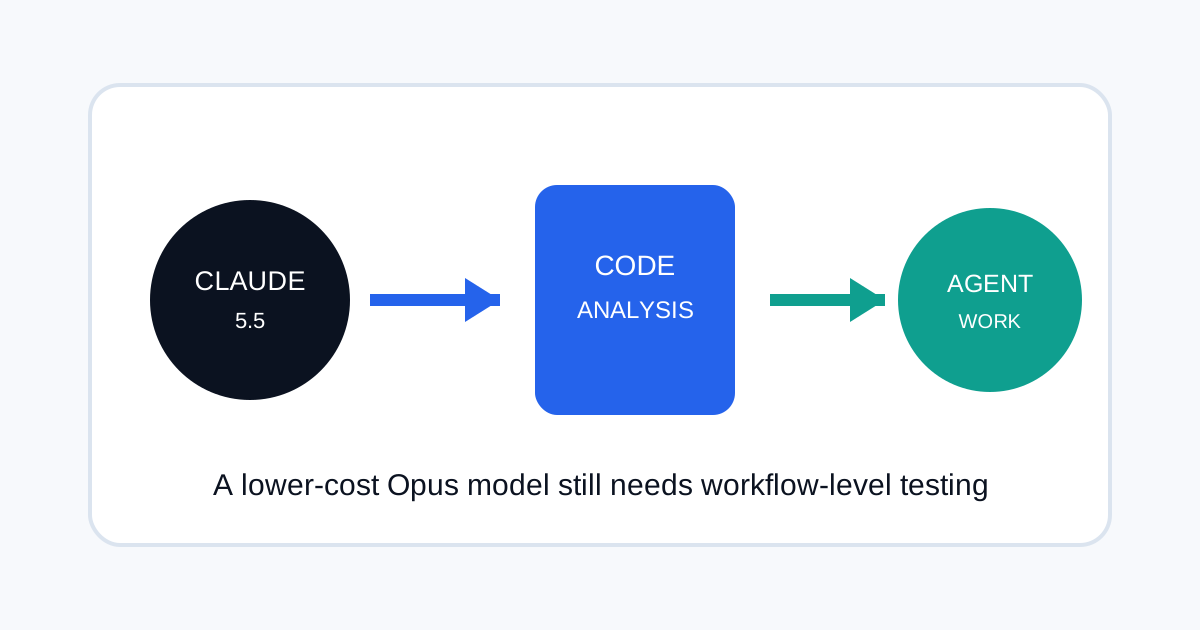
Anthropic publishes benchmark results, but a benchmark cannot predict every company's production workload. A model can score well on a coding benchmark and still struggle with an unfamiliar repository, internal API, company style guide or deployment rule.
The right test is a representative task set. Use real anonymized tasks, compare several attempts, record failures and measure how much human correction is needed before the output is usable.
Opus 5.5 and agentic work
Anthropic's Fable documentation describes the broader 5.1 generation as capable of long-running work, browser tasks and managed agent workflows. Opus 5.5 is positioned in the same high-capability tier, so teams should apply similar controls around tool use and external actions.
For production agents, keep permissions narrow. The model should have only the credentials and tools needed for the current job. The surrounding software should record tool calls and external effects so the team can review what actually happened.
What SEO teams can learn
For SEO, a model like Opus 5.5 is most useful where the task is multi-step: technical audits, large-scale content research, log analysis, site-migration planning or code review. The strongest workflow is usually model plus tools plus source checks, not a single prompt that asks for a finished answer.
Use a repeatable evaluation set and compare time to verified completion. That gives a better view of business value than counting generated words or chat messages.
What is still unclear
Public documentation does not establish that Opus 5.5 will be the best fit for every enterprise workload. Availability, pricing, usage limits and feature access depend on the product and deployment path. Teams should test their own tasks before changing a production workflow.
For more context on Claude’s earlier agent workflow direction, read Claude Docs and Slides: A Practical Workflow for Real Work.
Practical takeaways
- Opus 5.5 is a new Claude 5.5 model focused on complex work.
- Anthropic says typical token-billed operating cost is about 40% lower than Opus 5.
- External evaluations are useful, but production testing still matters.
- For agents, keep tool permissions narrow and log external actions.
Frequently asked questions
When did Claude Opus 5.5 launch?
Anthropic announced Claude Opus 5.5 on September 22, 2026.
Is Opus 5.5 cheaper than Opus 5?
Anthropic says Opus 5.5 costs 40% less to run than Opus 5 on typical workloads billed by token. Your actual cost depends on usage.
Can I use Opus 5.5 for agents?
Anthropic positions the model for complex and agentic work. Whether a specific agent deployment can use it depends on the product, access path and tool configuration.
Sources
- Anthropic — Introducing Claude Opus 5.5
- Anthropic — Claude Fable 5.1
- Anthropic — When AI builds itself