What changed in AI Mode?
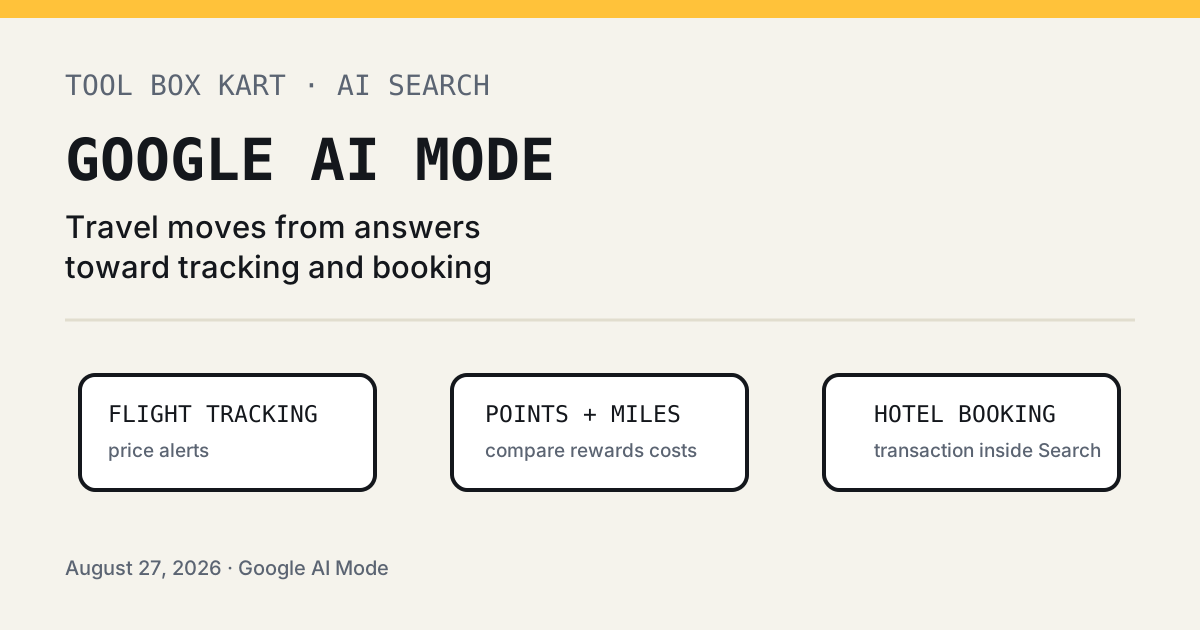
On August 27, 2026, Google announced three travel upgrades for AI Mode in Search. Users can ask AI Mode to track flight prices, see flight and hotel costs in rewards points or miles, and, where supported, complete hotel reservations through a Google flow.
Google says flight price tracking is available in more than 180 countries and territories, with an EEA exclusion in the feature's footnote. The company says the pricing data comes from more than 300 partner airlines and travel sites.
Hotel booking is narrower. Google says it has started rolling out in the United States in English. Users can select a hotel, choose a room, review details such as cancellation policy, and continue through Google with Google Pay. The hotel or booking platform remains the merchant of record.
The three features are not equally available
| Feature | What Google says | Availability |
|---|---|---|
| Flight price tracking | Set a price alert from the AI Mode conversation and receive email updates when prices change. | More than 180 countries and territories, excluding the EEA. |
| Points and miles rates | See flight and hotel costs in supported loyalty currencies. | Globally available in supported AI Mode locations and languages, with some EEA limitations noted by Google. |
| Hotel booking | Discover hotels, compare details, and continue to booking through Google. | Starting in the U.S. in English; rolling out. |
This split matters for international SEO. A travel company should not assume that one AI Mode feature has the same availability in every market.
Why this is bigger than a travel feature update
Traditional search usually ends with a list of pages. AI Mode can now take more of the workflow into the conversation.
A normal search might help a traveler find a flight, then send that person to another service to set a price alert. In AI Mode, Google is bringing price monitoring into the search experience itself. Hotel booking pushes the workflow another step by allowing a reservation flow to start and finish without the same sequence of separate searches.
That makes AI Search less like a page-finding layer and more like an action layer. Google's broader AI Search roadmap already includes search agents, agentic booking, and custom experiences, so this travel update fits into a larger move toward action-oriented Search. Google's I/O 2026 AI Search announcement provides the wider context.
Search is becoming a transaction layer
The hotel feature is especially important because it connects discovery with an actual commercial transaction.
Google is not replacing the hotel or booking company as the merchant. Instead, it is moving more of the decision process into its own conversational interface and then passing the transaction through supported partners.
For publishers and travel sites, this raises a new question: how much value is created by being the final booking destination versus being one of the sources that AI Mode uses to build an answer?
That question is still open. The direction is clear enough to watch: more search journeys can now happen without a traditional click-first path.
What this means for SEO
1. Optimize for accurate business and product data
AI-driven Search needs reliable inputs. Travel businesses should keep hotel details, room information, availability signals, pricing data, location information, policies, and business details accurate wherever those facts are published.
2. Build content that answers planning questions
Travel SEO should not stop at destination landing pages. Useful planning content can answer questions around dates, routes, neighborhoods, hotel differences, cancellation rules, loyalty programs, and trip constraints.
3. Make important information easy to extract
Clear headings, descriptive copy, structured data where appropriate, strong internal linking, and consistent facts can make important page information easier for search systems to interpret.
4. Watch clicks and conversions together
As AI interfaces handle more actions, a drop in organic clicks does not automatically mean that the business became less visible. SEO teams should watch impressions, branded demand, direct traffic, assisted conversions, bookings, and other business outcomes together.
For search-query analysis, the Google Search Console Regex Generator can help group AI-search and travel-related queries when they begin appearing in your Search Console data.
What travel businesses should do now
- Audit destination, hotel, room, policy, and business information for accuracy.
- Review technical SEO so key pages are crawlable, indexable, canonical, and internally connected.
- Track changes in impressions and queries around booking, pricing, and comparison intent.
- Measure completed bookings and leads alongside traditional organic traffic.
- Watch how Google changes AI Mode availability by country and feature.
Travel publishers should avoid making unsupported claims about being "optimized for AI Mode." There is no single confirmed checklist that guarantees inclusion in Google's AI answers or booking flows.
What to watch next
The next important development may be expansion beyond hotel booking. Google has already described agentic booking as a broader part of its Search direction. More categories could follow the same pattern: describe a need, compare live options, choose a result, and complete the action.
For SEO teams, this could change how success is measured. Visibility may increasingly involve being represented inside an AI-generated decision process, not only winning a conventional blue-link position.
That does not make traditional SEO irrelevant. It makes source quality, structured information, brand trust, useful content, and strong technical foundations more important because AI systems still need information to work with.
Bottom line
Google's August 27 travel update is a clear step toward action-oriented AI Search. Flight tracking brings monitoring into the conversation, rewards pricing adds another layer of comparison, and hotel booking connects search with a transaction.
For travel businesses, the practical response is to make their information accurate, their important pages technically strong, and their content useful for real planning questions. For SEOs, the bigger lesson is to track not only rankings and clicks, but how search interfaces are changing the path from discovery to action.
FAQ
What can Google AI Mode now do for travel?
Google says AI Mode can track flight prices, show flight and hotel costs in points or miles, and support hotel booking through Search in the United States.
Where is Google AI Mode hotel booking available?
Google says hotel booking has started rolling out in the United States in English with supported hotel chains and booking platforms.
Is Google AI Mode replacing travel websites?
Not based on this update alone. Google is adding more travel discovery and transaction features inside Search while continuing to use partner airline, hotel, and travel-site data and links.
What does AI Mode travel mean for SEO?
Travel businesses may need to optimize for being discovered and represented in AI-driven results, with clear inventory, accurate business information, useful content, and strong technical foundations.