GLM-5.3-Flash: Z.ai Reveals the AI Model Behind Ox Alpha
Z.ai has confirmed that the mysterious Ox Alpha model was a preview of GLM-5.3-Flash, a new open model built for coding, agents, long context and multimodal work.
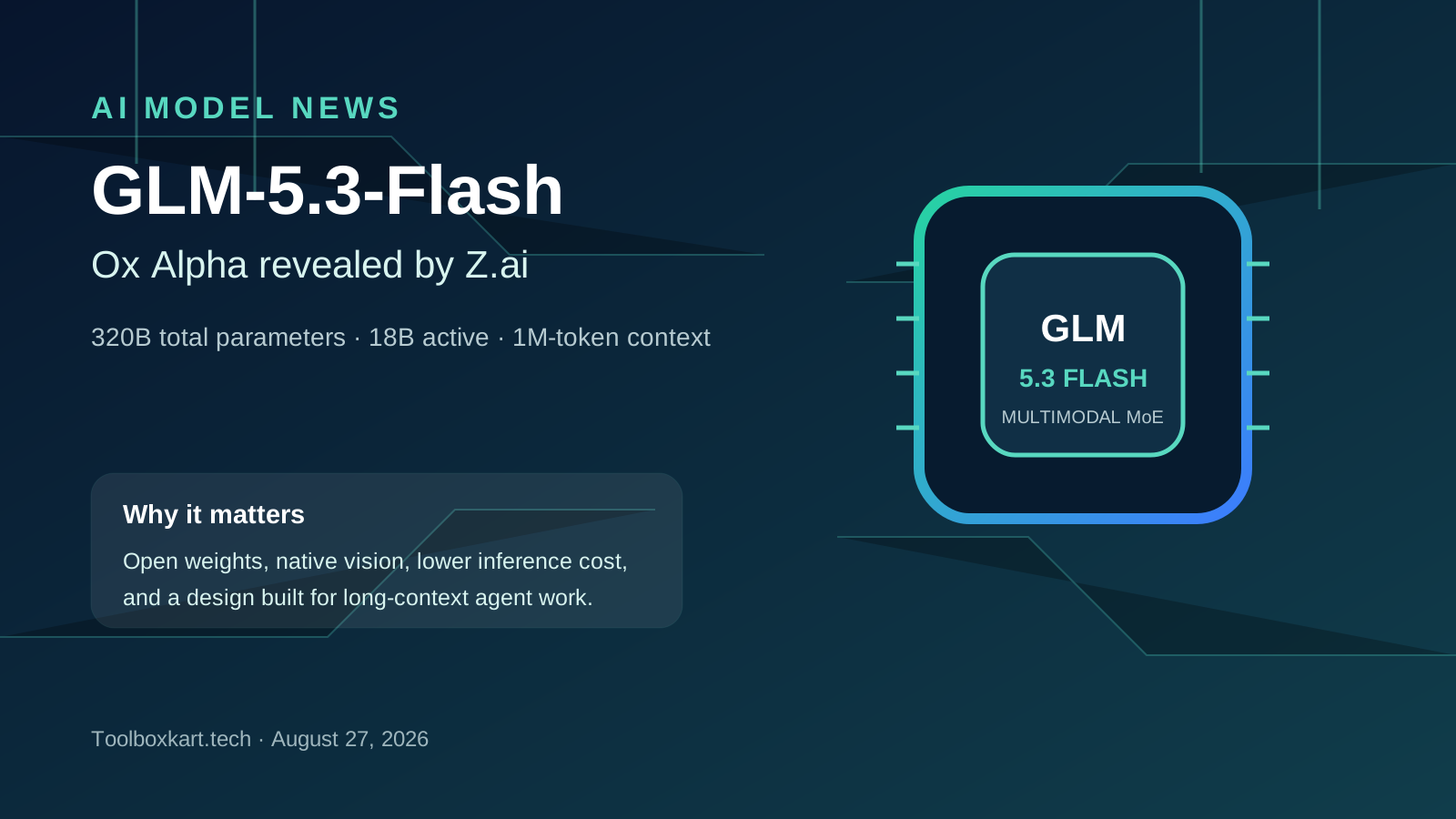
AI developers have spent the past week trying to identify Ox Alpha, a model that appeared without a clear public identity on developer platforms. Z.ai has now removed the mystery. Its documentation says GLM-5.3-Flash was tested anonymously as ox-alpha on OpenCode and OpenRouter before the public release. citeturn2view1
What is GLM-5.3-Flash?
GLM-5.3-Flash is the newest model in Z.ai's GLM-5 family. Z.ai calls it the first native multimodal model in the series. It is designed to work with text, images, video and files, while also handling coding and agent tasks. citeturn2view1
The model has 320 billion total parameters, with about 18 billion active parameters for each token. This is a mixture-of-experts style setup: the model does not need to use every parameter for every part of a request.
That design matters because model size alone does not tell you how expensive a model is to run. The amount of compute used during inference is also important.
Why was it called Ox Alpha?
Before the public name was known, Z.ai ran the model under the name ox-alpha on OpenCode and OpenRouter. The company says the goal was to gather real user feedback before the official release. Z.ai also says the model became the most popular model of that week during the test. citeturn2view1
This is an interesting release method. Instead of only testing the model in a closed lab, Z.ai exposed it to real developer workflows and then used that feedback before attaching the final product name.
How large is the context window?
GLM-5.3-Flash supports a 1 million token context window, according to Z.ai's developer documentation. citeturn2view1
A large context window can help when a task includes many files, long documents, large codebases, screenshots or long conversations. It does not mean every task needs one million tokens. For normal prompts, a smaller context is often enough.
What makes the architecture different?
Z.ai says GLM-5.3-Flash combines sparse attention and linear attention. The company reports that, compared with GLM-5.3, the design cuts attention computation by about 3.01 times and KV cache size by about 4.44 times. citeturn2view1
In simple terms, the model tries to spend less compute and memory on attention while keeping useful long-context behavior. This is important because long-context AI can become expensive when every part of a large input must be handled in the same way.
What can its multimodal system do?
The model is built to use visual information inside the work process, not only as a separate image question feature. Z.ai says it can inspect interfaces, rendered results and interaction feedback while coding. It can then test and improve its output. citeturn2view1
For a developer, that can change the workflow. A model can look at a screenshot, write code, inspect the result and make another change. The same idea can apply to games, 3D work and other visual tasks.
Is it useful outside coding?
Yes. Z.ai lists office work, financial research and document processing as target workflows. It says the model can break down tasks, call tools, review its own output and produce files such as PPTX, PDF, DOCX and XLSX. citeturn2view1
That does not mean every generated file will be correct. For business work, users still need to check numbers, sources and important decisions. The useful part is that the model is being designed for a full workflow rather than only a chat response.
What does Z.ai claim about performance?
Z.ai reports an Artificial Analysis Intelligence Index v4.1.1 score of 57 at a discounted cost of $0.045 per task. It also reports stronger results than GLM-5.2 on several coding and agent benchmarks, including DeepSWE v1.1 and AutomationBench. citeturn2view1
These are Z.ai's reported results. They should not be treated as an independent guarantee of performance. Benchmark results depend on test setup, model settings and the exact version used.
What is important about Chinese AI chips?
Z.ai says it served GLM-5.3-Flash on a large cluster of Chinese AI chips during testing. The company built an inference engine on top of SGLang and says it improved end-to-end serving performance by 3 times on the same hardware compared with its initial baseline. citeturn2view1
This is important beyond the model itself. AI progress is not only about better models. It also depends on chips, memory, networking and inference software. A model that can run efficiently on different hardware gives developers more options when hardware supply or export rules limit access to a particular chip family.
What should developers pay attention to?
There are four practical points.
- Long context: useful for large codebases, documents and agent workflows.
- Native vision: useful when the final result must be inspected visually.
- Open model access: the model is available as an open model, which gives developers more control over deployment.
- Cost efficiency: the architecture is designed to reduce inference cost, which matters for high-volume agents.
How can you use GLM-5.3-Flash?
Z.ai documents the API model code as glm-5.3-flash. The developer documentation also lists a 1 million token context window and image input through the API. citeturn2view1
Z.ai also says GLM-5.3-Flash is available through its GLM Coding Plan, where it provides 3 times the available quota compared with GLM-5.3. citeturn2view1
What does this release mean for the AI market?
The bigger story is the focus on capability per unit of compute. AI companies are still pushing model quality, but they also need models that can run at a useful cost.
GLM-5.3-Flash combines a large total parameter count with a much smaller active parameter count, a long context window, native multimodal work and an inference architecture aimed at lower serving cost. If the reported results hold up in independent testing, that mix could make it attractive for coding agents and other high-volume workloads.
It is also another sign that open model development is moving toward full systems. The model, serving stack and hardware are being considered together. That can matter as much as the model weights themselves.
FAQs
Was Ox Alpha actually GLM-5.3-Flash?
Yes. Z.ai says it tested GLM-5.3-Flash anonymously as ox-alpha on OpenCode and OpenRouter before the public release. citeturn2view1
Does GLM-5.3-Flash support images and video?
Yes. Z.ai describes it as the first native multimodal model in the GLM-5 series and lists visual understanding for images, videos and files. citeturn2view1
Can GLM-5.3-Flash handle very large inputs?
Yes. The API documentation lists support for a 1 million token context window. citeturn2view1
Is it open source?
Z.ai describes it as an open model and has made its weights available through Hugging Face under the MIT license. Developers should still review the current model license and hardware requirements before deployment.
Final thoughts
GLM-5.3-Flash is worth watching because it combines several trends that matter in 2026: open models, multimodal agents, long context and lower-cost inference.
The most useful test will not be a single benchmark. It will be how well the model performs in real coding, research and agent workflows at its actual running cost. Developers now have the chance to test those claims themselves.
Primary source: Z.AI Developer Documentation — GLM-5.3-Flash. Z.ai launch article.