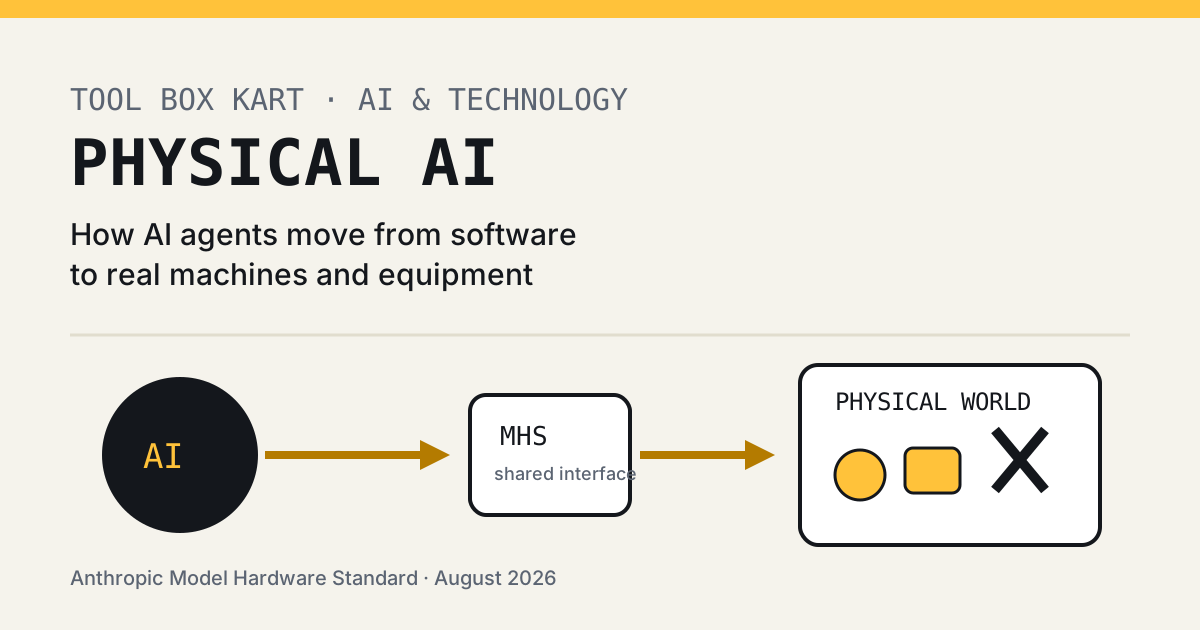
For years, the main story in AI was software: models generated text, wrote code, searched the web, called APIs, and completed digital tasks. Anthropic's Model Hardware Standard points to the next step: agents that can connect software reasoning to real equipment.
That makes the announcement more important than another chatbot feature. It sits at the intersection of AI agents, robotics, scientific automation, manufacturing, and machine control.
What is Physical AI?
Physical AI is a broad term for AI systems that can perceive and act in the physical world. Instead of stopping at a text response or a software action, the system can use cameras, sensors, robots, machines, or other hardware to change or measure something in the real world.
It is useful to think of the shift as:
- Text → AI generates information.
- Software → AI uses digital applications.
- APIs → AI calls external services.
- Agents → AI plans and executes multi-step workflows.
- Physical AI → AI agents can operate equipment and respond to real-world results.
Physical AI does not automatically mean humanoid robots. A robotic arm, laboratory liquid handler, microscope, industrial machine, or camera can all be part of a physical AI system when software can control and observe them.
What Anthropic announced
Anthropic opened a research preview of the Model Hardware Standard (MHS) on August 27, 2026. The company describes MHS as a shared specification that helps AI agents safely operate physical devices.
Anthropic says the standard is being tested with scientific research labs and advanced manufacturers. The examples include microscopes, liquid handlers, robotic arms, cameras, and other equipment used in research and manufacturing workflows.
The broader goal is to replace a collection of one-off integrations with a common way for agents and devices to communicate. Anthropic also says MHS is model-agnostic and can work with programmable devices using standard protocols such as the Model Context Protocol.
Why hardware integration is the real problem
Connecting an AI model to a single machine is not the same as building an agent that can work across a real laboratory or factory.
Physical equipment often comes from different vendors. A robot may use one control system, a camera another interface, and a laboratory instrument may expose a completely different API, scripting layer, or even only a graphical interface.
Anthropic says this integration work can take weeks or months in some environments. MHS is designed to reduce that repeated integration work by giving devices a standard driver and description.
This matters because agent capability is only useful when the agent can reliably understand what a device can do, what state it is in, and which actions are safe.
How the Model Hardware Standard works
Anthropic's design centers on a standardized driver that sits between software and a physical device. The driver exposes simple operations such as reading a value or writing a setting, while also describing the device in a consistent format.
| Layer | Role |
|---|---|
| Physical device | Robot, camera, microscope, liquid handler, laser, or other programmable equipment. |
| MHS driver | Translates the device's underlying interface into a standard representation. |
| Device description | Records capabilities, states, characteristics, controls, and safety limits. |
| Agent | Plans steps, reads results, adjusts parameters, and coordinates multiple devices. |
| Execution layer | MCP, command-line tools, or code files can carry out the device operations. |
The important idea is not that MHS makes every machine intelligent. It creates a more consistent interface that lets an agent reason across several machines without learning a completely different control model for every device.
What Anthropic says it has demonstrated
Anthropic reports that MHS has been used in early experiments where an AI-controlled system coordinated multiple pieces of laboratory equipment. One example combined a liquid handler, plate reader, robotic arm, monitoring cameras, and an AI orchestrator.
In that experiment, Anthropic says the system could evaluate a result, reject a poor run, change parameters, and execute another run without human input. Anthropic reports that the lab workflow ran roughly three times faster in its test.
Those are company-reported results from an early research preview, not a general benchmark for physical AI. The distinction matters. The results show what Anthropic's team and partners say they achieved in a specific environment; they do not prove that the same performance will transfer to every lab, factory, or robot.
Why this could matter for scientific research
Scientific experiments often involve repeated mechanical steps: moving samples, changing conditions, collecting measurements, checking results, and repeating a procedure.
AI agents could eventually manage more of that loop. An agent might interpret a research goal, break it into steps, control equipment, inspect measurements, adjust parameters, and continue the experiment.
That does not remove the need for scientists. Experimental design, interpretation, judgment, safety, and deciding what question is worth asking remain human-heavy tasks. The opportunity is to reduce the repetitive work between an idea and its physical execution.
What this could mean for manufacturing
Manufacturing has a similar problem at a different scale. Factories already use automation, but automation systems can be tightly coupled to specific equipment and workflows.
A common interface for AI agents could make it easier to orchestrate multiple systems: inspect a machine, read a sensor, move a robot, change a parameter, check the result, and continue the workflow.
The key limitation is that physical work has consequences. A wrong answer in a text editor may waste time. A wrong command sent to industrial equipment can break a machine, damage materials, or injure a person.
Safety is not an optional feature
That is why the most important part of physical AI may not be the ability to issue commands. It is the ability to constrain those commands.
Anthropic says it is using the research preview to develop safety evaluations and best practices before making MHS open source. The company also says the current system does not work with hardware that has no programming interface, and that expert oversight is still needed because AI models have limitations in spatial and physical reasoning.
This is a useful warning for the wider AI industry: giving an agent access to a machine changes the risk model. Permissions, hardware limits, emergency stops, validation, monitoring, and human approval can become part of the AI system itself.
How this connects to the rise of AI agents
MHS fits into a larger shift in AI. Agents are moving from answering questions to taking actions.
Software agents can already navigate applications, call APIs, create files, run code, and perform multi-step jobs. Physical AI extends that same idea into machines and equipment.
At the same time, this creates a new layer of security risk. The industry is already discussing how more autonomous AI systems could increase the speed and scale of cyberattacks. ToolboxKart's AI cyberattack analysis looks at that wider shift from model capability to autonomous action.
What the long-term AI stack could look like
A useful mental model is:
- Foundation models: understand language, images, code, and other inputs.
- Agents: plan and manage multi-step goals.
- Interfaces: connect agents to software and services.
- Hardware standards: give agents consistent ways to discover and operate machines.
- Physical systems: carry out actions and generate new data.
- Feedback loops: feed physical results back to the agent for the next decision.
That final feedback loop is what makes the idea especially interesting. Instead of a chatbot giving instructions to a scientist, an agent could eventually participate in a closed loop where it acts, observes, evaluates, and acts again.
Is Physical AI ready for mass adoption?
Not yet. The technology is promising, but there are clear constraints.
- Many devices still lack useful programming interfaces.
- Hardware vendors use different control systems and data formats.
- Real-world environments are less predictable than software.
- AI models can misunderstand physical states or fail to recognize hardware problems.
- Safety validation becomes much more important when actions can have physical consequences.
- Many deployments will need specialized engineering, monitoring, and human oversight.
Anthropic's current MHS release is a research preview, not evidence that fully autonomous physical laboratories or factories are ready for general deployment.
What businesses should watch
Businesses should watch the standards layer as closely as the models. A more capable model is only one part of a physical AI system. Common device interfaces, sensors, safety controls, orchestration software, and reliable feedback are what can turn a model into an operational system.
For technology teams, the practical questions are straightforward: Which machines have programmable interfaces? What data can they expose? Which actions can be automated safely? Where is human approval required? And can the same workflow move between equipment from different vendors?
For SEO and content teams, Physical AI also creates a new search category. People will increasingly look for explanations of embodied AI, AI robotics, agentic automation, lab automation, AI-controlled machines, and the standards that connect models to hardware.
For query research around emerging topics, ToolboxKart's Google Search Console Regex Generator can help group related queries once the topic starts generating impressions.
What happens next?
Anthropic says it plans to use the research preview to improve safety evaluations and expand the standard with partners before making MHS open source.
The bigger question is whether a shared hardware interface can become useful beyond Anthropic's own ecosystem. MHS is model-agnostic by design, which makes interoperability one of the most important parts to watch.
If device manufacturers, robotics developers, laboratories, and AI-agent frameworks adopt compatible interfaces, physical AI could become easier to build. If each company creates a separate control layer, the industry may remain fragmented.
Bottom line
Anthropic's Model Hardware Standard is important because it targets a practical bottleneck in AI agents: connecting software reasoning to real equipment.
The announcement does not mean AI agents can now run factories or laboratories without people. It shows an early architecture for making physical equipment easier for agents to discover, understand, control, and coordinate.
The long-term opportunity is bigger than one Anthropic release. If AI moves from text to software, APIs, agents, and then physical machines, the interface between models and hardware could become a major layer of the technology stack.
FAQ
What is physical AI?
Physical AI refers to AI systems that can sense, reason about, and act on the physical world through connected devices, robots, machines, or other programmable equipment.
What is Anthropic's Model Hardware Standard?
The Model Hardware Standard (MHS) is an early shared specification from Anthropic for AI agents to discover, understand, and operate programmable physical devices through a common interface.
What devices can MHS connect to?
Anthropic says MHS is designed for programmable devices and has been tested with equipment including microscopes, liquid handlers, robotic arms, cameras, and other laboratory or manufacturing hardware.
Is the Model Hardware Standard open source yet?
No. Anthropic currently describes MHS as a research preview shared with selected partners while it develops safety evaluations and best practices ahead of a planned open-source release.