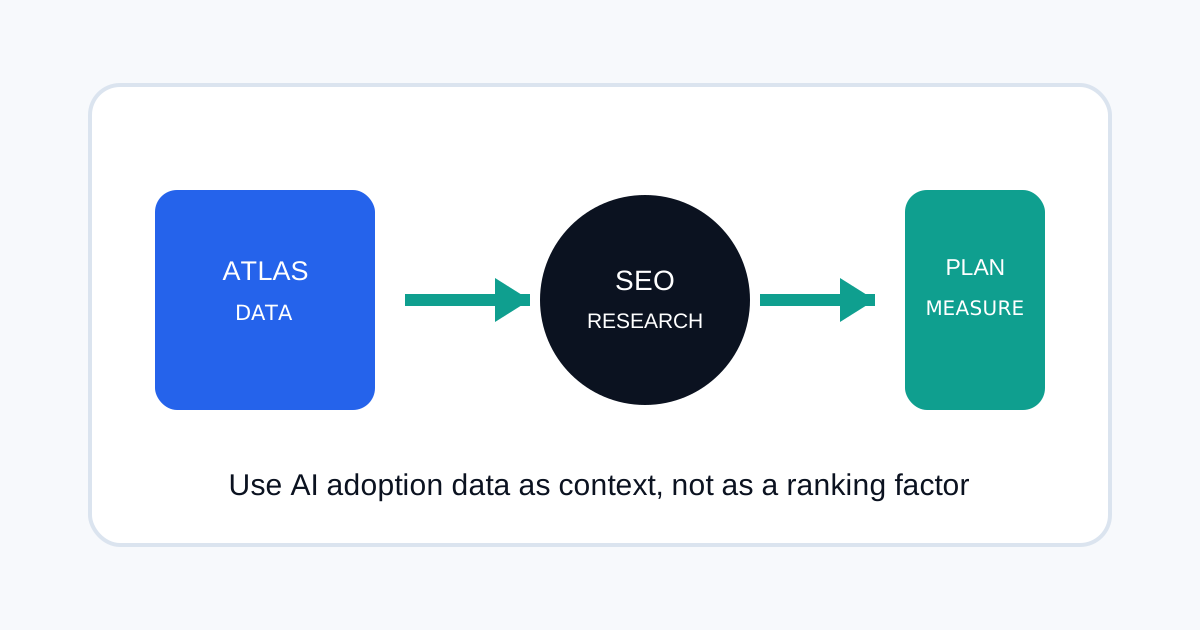
Google's AI & Economy ATLAS gained a new public data experience on September 15, 2026. Google says the project brings together millions of data points about how people and occupations use AI, with new visualizations that make the data easier to explore. For SEO teams, the useful opportunity is not to treat ATLAS as a ranking-factor source. It is to use the data as market context for research, content planning and AI-search strategy.
What AI & Economy ATLAS provides
Google describes ATLAS as an interactive, open-access experience for exploring AI usage by occupation, country and other dimensions. The September update also includes research from Google, Google DeepMind and MIT FutureTech on how scientists are using AI.
That makes ATLAS different from Search Console or a keyword database. It is not your site's performance data. It is a source of broader market context that can help explain why a topic is growing, which audiences may be adopting AI, and where new research questions exist.
Three data points SEO teams can use carefully
| ATLAS finding | SEO use | Limit |
|---|---|---|
| India's creative work AI usage is 19% | Explore new AI-content and creative-service demand. | Not a search-volume estimate. |
| Technical occupations lead U.S. usage | Map content by technical audience needs. | Does not prove purchase intent. |
| Scientists report nearly 7 hours saved per week | Research how AI changes professional workflows. | Self-reported productivity is not revenue. |
Use ATLAS for topic discovery
A practical workflow starts by using ATLAS to find a market pattern, then moving to search-specific evidence. For example, if an occupation shows fast AI adoption, build a list of problems that occupation may now need to solve. Then validate the topics with Search Console, keyword tools, customer questions, community discussions and first-party product data.
This keeps ATLAS in the right role: a research input, not the final proof of demand.
Use ATLAS for content clustering
AI adoption can change what buyers ask. A technical team that starts using AI for coding may need different documentation, security guidance and workflow tools. A creative team using AI may need review systems, asset standards and publishing controls.
For an SEO content plan, map the adoption signal to user jobs rather than writing a generic “AI is changing industry X” article. That creates more useful long-tail topics.
Use ATLAS for AI-search research
AI search changes how people discover information, but ATLAS does not directly measure your brand's appearance in AI answers. You still need your own visibility dataset: query lists, citations, mentions, referral traffic, conversions and page-level engagement.
ATLAS can provide context around who is adopting AI and where workflows are changing. Your AI-search monitoring should then test whether your content appears for those new tasks and questions.
Do not turn the data into a ranking claim
A common SEO mistake is to take an industry statistic and turn it into a claim about Google rankings. ATLAS cannot tell you that a keyword will rank, that a topic has a certain search volume, or that an AI tool is a direct Google ranking factor.
Use the data to generate hypotheses. Test those hypotheses with search and business evidence.
A 30-minute ATLAS workflow for SEO teams
- Choose one industry or audience you care about.
- Use ATLAS to identify an AI-adoption signal or workflow pattern.
- List the new problems created by that workflow.
- Validate the problems with search, customer and first-party data.
- Group the validated questions into one pillar and supporting pages.
- Track impressions, clicks, citations, assisted conversions and real business actions after publishing.
What the science research adds
Google's September research says nearly half of surveyed scientists use some form of AI every day and that scientists report saving almost seven hours a week. It also notes a new bottleneck: faster idea generation can create a backlog of hypotheses waiting for physical experiments or clinical validation.
For SEO teams, that is a broader lesson about AI adoption. Faster content production is not the same as faster business results. The bottleneck often moves downstream into review, validation and implementation.
For another measurement-focused workflow, see Google AI Contribution Pilot: What SEOs Should Measure.
Practical takeaways
- Use ATLAS as market context, not as a keyword or ranking database.
- Turn adoption patterns into user problems and validate them with search evidence.
- Separate AI-search visibility measurement from broader AI adoption statistics.
- Measure the downstream business result, not only content output.
Frequently asked questions
Is Google AI & Economy ATLAS an SEO tool?
Not in the usual sense. It is an open-access research and visualization experience about AI usage. SEO teams can use it as a research input.
Can ATLAS show Google search volume?
No. ATLAS provides broader AI adoption data rather than a replacement for keyword and search-performance tools.
How should SEOs use ATLAS data?
Use it to spot audience and workflow changes, then validate those ideas with search, first-party and business data before building content.