Most SEO advice about “AI search” treats Google AI Overviews, Perplexity, and ChatGPT Search as three versions of the same thing. They are not. Each one is a structurally different product with a different crawler, a different index, and different citation logic. Optimizing for one without understanding the others is how effort gets wasted.
Before any platform comparison makes sense, four common confusions need clearing up.
What Google AI Overviews Actually Is (and What It Replaced)
AI Overviews is not a search engine. It is a feature inside Google Search. It generates an AI-written summary at the top of certain results pages and cites sources below that summary.
Google previously called this feature Search Generative Experience (SGE). That name ended in May 2024, when Google renamed and officially launched the feature as AI Overviews, according to Google’s Search Central documentation. Any article still using the term SGE is pulling from outdated research.
AI Overviews also do not appear on every query. Google shows them selectively, with heavier presence on informational and how-to queries.
What Perplexity Is and Is Not
Perplexity is an answer engine. Users type a question and get a direct answer with numbered citations. It has its own crawler, PerplexityBot, which indexes content independently.
It is not a traditional search engine. Users do not see a list of ten blue links. They see one synthesized answer with sources attached. That UX difference has real SEO implications: citation is the only way to exist in a Perplexity result.
What ChatGPT Search Is — and How It Differs from ChatGPT
OpenAI launched ChatGPT Search in October 2024 as a distinct product from the base ChatGPT assistant. The two behave differently when it comes to sourcing content.
ChatGPT Search pulls from the Bing index. It does not maintain its own web crawler for fresh content discovery in the same way Perplexity does. This means if Bing does not index your site, ChatGPT Search will not cite it. Before ChatGPT Search launched, OpenAI’s earlier pre-release branding called it SearchGPT — that name is now deprecated.
Base ChatGPT with browsing enabled is a separate experience with different behavior. Do not conflate the two when building strategy.
Why Treating All Three as “AI Search” Breaks Your Strategy
Each platform uses a different bot, pulls from a different source index, and surfaces content in a different format. A decision made for one does not automatically apply to the others.
| Platform | Type | Crawler | Index Source | Citation Style |
|---|---|---|---|---|
| Google AI Overviews | Search feature | Googlebot | Google index | Linked sources below summary |
| Perplexity | Answer engine | PerplexityBot | Own index | Inline numbered citations |
| ChatGPT Search | AI search product | GPTBot + Bingbot | Bing index | Linked sources in answer |
How Big Is Each Platform Actually? (Traffic Reality Check)
The honest answer is that AI Overviews touches a vastly larger audience than Perplexity and ChatGPT Search combined. That does not mean the other two are irrelevant. It means the nature of the opportunity differs sharply by platform.
Google AI Overviews: Massive Reach, Complex Impact
Google processes more than 8 billion searches per day. AI Overviews appear on a significant portion of informational queries, which means the feature already affects more users than Perplexity and ChatGPT Search will reach in aggregate for the foreseeable future.
The CTR impact is the complication. Sites that appear as cited sources in AI Overviews do not automatically see traffic gains. In many cases, the overview answers the query well enough that users do not click through. Search Console data shows impressions holding or rising while clicks stay flat for pages cited in overviews.
This is the zero-click tension: you get visibility, but the click stays with Google.
Perplexity: Small but High-Intent Traffic
Perplexity reached approximately 100 million monthly active users by early 2025, a significant jump from its 2023 baseline, though still a fraction of Google’s scale.
The traffic quality difference is the important factor. Perplexity users arrive with a specific question and read the cited sources. Click-through rates from Perplexity citations run higher than what AI Overview citations produce. The user who clicks from Perplexity is further along in their decision-making process.
Perplexity also operates a Publisher Program, which gives editorial sites a revenue share when their content is cited and clicked. Most SEO coverage has ignored this entirely.
ChatGPT Search: Growing Fast, Still Maturing
ChatGPT crossed 400 million weekly active users by early 2025, according to OpenAI’s public statements, though that figure covers all of ChatGPT, not ChatGPT Search specifically. The dedicated search product is a subset of that base and is still building adoption.
Referral traffic data from publishers using ChatGPT Search is thin but directional: click volume exists, intent is high, and the user segment skews toward tech-forward early adopters. For B2B and SaaS sites, that segment overlaps closely with their buying audience.
The Honest Comparison
| Metric | AI Overviews | Perplexity | ChatGPT Search |
|---|---|---|---|
| Reach / Scale | Dominant | Growing | Early stage |
| Citation click-through likelihood | Low to medium | Higher per citation | High per citation |
| Query type dominance | Informational, how-to | Research, complex questions | Research, comparison |
| Crawl transparency | Google Search Central | PerplexityBot documented | GPTBot + Bing |
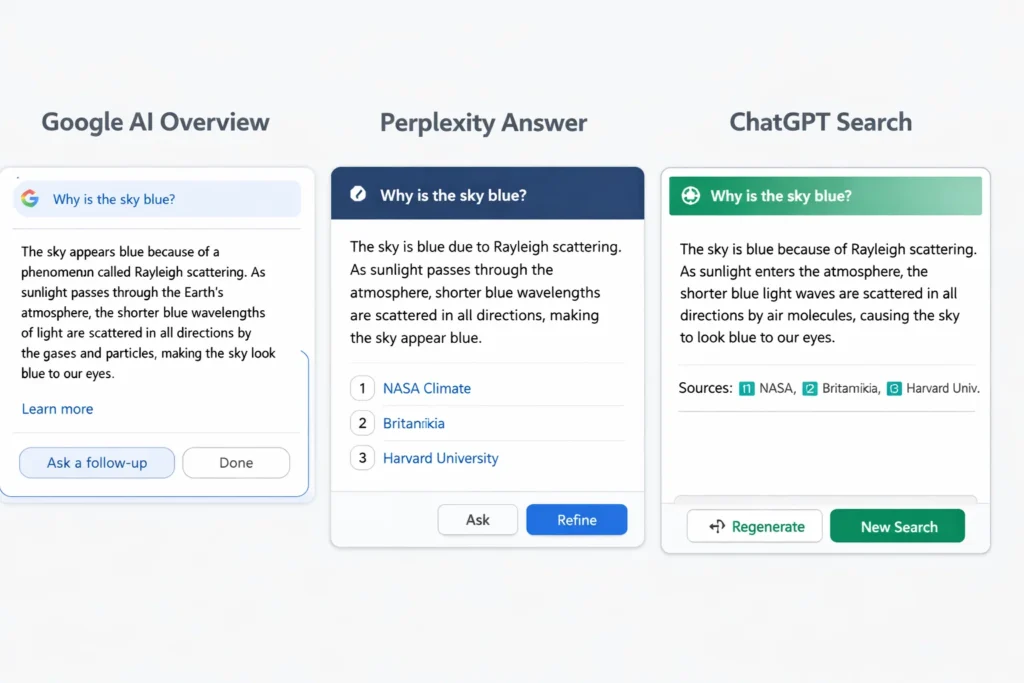
How Does Each Platform Decide What to Cite?
Citation selection is where practitioner-level understanding separates from generic SEO advice. Each platform runs a different selection process, and the overlap is smaller than most guides suggest.
Understanding how E-E-A-T signals apply to AI citation changes how you approach content authority across all three platforms.
How Google Selects AI Overview Sources
Google’s AI Overviews draw heavily from pages that already perform well in organic search. Being in the top ten for a query does not guarantee citation, but it is a strong correlating factor. Pages that do not rank well organically are rarely cited.
E-E-A-T signals matter at the citation selection level. Google weights demonstrated expertise, authorship transparency, and source authority. For health and finance queries, the bar is higher — these query categories trigger stricter source selection than general how-to content.
Schema markup helps Google understand page structure and content type. FAQ and HowTo schema types show a consistent presence in cited pages, though structured data alone does not guarantee citation.
How Perplexity Selects What to Cite
PerplexityBot crawls the web independently. Pages blocked in robots.txt from PerplexityBot are invisible to the platform, regardless of how well they rank in Google.
Recency carries significant weight in Perplexity’s selection. Fresh content, or evergreen content with visible update signals, outperforms older static pages. This matters because Perplexity users often ask questions about evolving topics where recent information has real value.
Every claim in a Perplexity answer gets a citation. That explicit source-linking is the platform’s core UX promise. To check if Perplexity cites your site, run your domain as a search query directly in Perplexity and look at sources returned across recent answers.
How ChatGPT Search Selects Sources
Bing indexation is the gating factor. If Bing does not have your pages indexed, ChatGPT Search will not surface them. This is counterintuitively straightforward. Bing Webmaster Tools is not optional setup for sites that want ChatGPT Search eligibility — it is the first required step.
OpenAI’s model layer then filters Bing results. The model applies its own ranking logic on top of what Bing returns, weighting clarity, directness, and topical authority. GPTBot crawls separately from Bingbot. Blocking GPTBot in your robots.txt may reduce ChatGPT’s ability to access fresh page versions, even if Bing has the page indexed.
The One Signal All Three Share — and the One That Splits Them
All three platforms respond to the same baseline content quality: direct answers placed early, clear heading structure, short paragraphs, and explicit sourcing of claims. These are not groundbreaking signals. They map to what good content has always required.
Where the three diverge is authority weighting. Google weights domain authority and E-E-A-T depth most heavily. Perplexity weights recency and citation structure — pages that cite their sources perform better because they match the platform’s own UX model. ChatGPT Search weights Bing presence and clean indexation as the foundation, with model-level filtering on top.
What Does “Winning” Look Like on Each Platform?
Success means something different on each platform. Conflating the metrics leads to incorrect conclusions about whether your optimization effort is working.
Google AI Overviews — Winning = Surviving the CTR Shift
Being cited in AI Overviews is rarely a traffic gain event. More accurately, it is a traffic preservation event. Pages that do not appear in overviews on queries where overviews exist are losing visibility that previously came from position one or two.
Measure AI Overview presence through Search Console. Filter by queries where your pages appear and look at the impression-to-click ratio. A rising impression count with a flat or declining click count points to AI Overview presence eating the clicks that organic position used to capture.
The queries where clicks still happen despite an AI Overview present are usually those requiring deeper engagement: complex how-to content, multi-step processes, or topics where the overview’s answer is insufficient to resolve the query alone.
Perplexity — Winning = Citation + Click-Through
A Perplexity citation is worth more per impression than an AI Overview citation. The click-through behavior is stronger because Perplexity users expect to read sources, not just skim an answer.
Detect Perplexity referrals in GA4 by filtering referral traffic for the domain perplexity.ai. The numbers will be smaller than Google referral traffic, but the session depth and engagement metrics typically look better.
If your site is editorial in nature, the Perplexity Publisher Program represents a direct monetization channel on top of referral traffic. Apply at Perplexity’s publisher portal. Most eligible editorial sites have not done this yet.
ChatGPT Search — Winning = Brand Presence in Answers
ChatGPT Search click volume is still low relative to Google. But the users generating those clicks are high-intent, AI-native, and disproportionately influential in B2B and tech buying decisions.
Citation in ChatGPT Search functions as a brand trust signal in a user segment that may interact with Google rarely. Tracking is limited. Direct referrals from chatgpt.com appear in GA4 referral reports, but ChatGPT Search does not yet surface in a way that cleanly separates it from other ChatGPT traffic sources.
Which Platform Should You Prioritize? (The Framework)
“All three matter” is not a strategy. Here is the concrete prioritization logic.
The Effort-vs-Impact Matrix
| Effort Level | Platform | Impact | Reason |
|---|---|---|---|
| Low | Google AI Overviews | High | Most sites are partially optimized already via organic SEO |
| Medium | Perplexity | Medium | Recency + formatting adjustments; publisher program available |
| Higher | ChatGPT Search | Speculative near-term | Requires Bing setup; long time horizon to meaningful volume |
Start with AI Overviews because your existing SEO work already creates partial eligibility. The marginal investment to improve citation probability is smaller here than on the other two platforms.
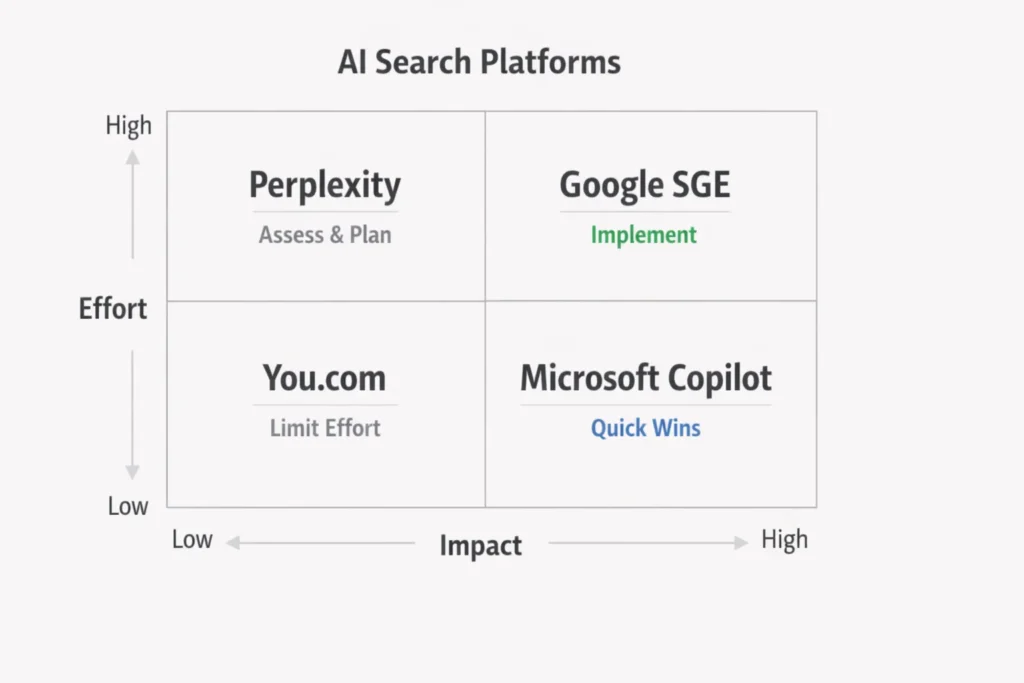
Priority by Site Type
Publisher or Editorial Sites
AI Overviews and Perplexity should be your first and second focus in that order. Both platforms weight recency, and editorial sites produce fresh content by default. Apply to Perplexity’s Publisher Program immediately — it is an underused revenue channel.
ChatGPT Search is worth setting up Bing indexation for, but do not redirect significant editorial resources toward it yet.
SaaS or B2B Content Sites
ChatGPT Search moves up in priority here. Your buyers are already ChatGPT power users. A citation in ChatGPT Search reaches them in their natural research environment.
AI Overviews remain the primary volume driver. Perplexity is a strong secondary target for product comparison and buyer-intent content.
E-Commerce Sites
AI Overviews affect product query visibility, but the citation mechanic for transactional queries is different from informational content. Monitor AI Overview presence on product category and comparison queries, but do not over-invest.
Perplexity and ChatGPT Search have lower immediate priority for e-commerce. Review again in 12 months as both platforms mature.
Local Business Sites
All three AI platforms have less relevance to local SEO than Google Business Profile, local citations, and review signals. AI Overviews do appear for some informational local queries (“best dentist in [city]” style searches). Monitor, but do not let AI search optimization displace core local SEO work.
The Minimum Viable AI Search Strategy (For Resource-Constrained Teams)
Teams without dedicated capacity for all three platforms can cover the essential ground in four steps.
Step 1: Open Search Console and filter for AI Overview impressions. Identify which pages appear and which high-traffic pages do not. That gap is your first optimization target.
Step 2: Log into Bing Webmaster Tools and verify your site is indexed. Submit your sitemap if you have not already. This single action unlocks ChatGPT Search eligibility.
Step 3: Check your robots.txt file. Confirm that PerplexityBot and GPTBot are not blocked. If they are blocked, that was likely a blanket AI-crawler directive — make the decision deliberately, not by default.
Step 4: Add direct answers to the first 100 words of your top-performing pages. This one formatting change improves citation probability across all three platforms simultaneously.
How to Optimize Content for All Three Without Rebuilding Everything
The good news is that the content signals that help all three platforms overlap significantly. You do not need three separate content strategies.
Content Formatting Signals That Help All Three Platforms
Direct answers in the first 100 words are the single highest-leverage change most sites can make. All three platforms select content that resolves the query quickly, before context or explanation.
Question-formatted headings (H2 and H3) help AI systems understand what a section answers. Flat heading structures with vague labels (“Overview,” “Background”) create ambiguity that AI citation logic penalizes.
Short paragraphs and no padding are not style preferences. They are functional. AI systems parsing long, dense paragraphs extract less reliable signal than from tightly structured content with clear attribution.
Cite your sources inline. Perplexity rewards pages that already model the citation behavior it asks of its own answers.
Platform-Specific Adjustments
For AI Overviews
Implement structured data for your key content types. FAQ schema, HowTo schema, and Article schema all have documented relationships to AI Overview citation eligibility, per Google’s structured data documentation. Understanding which schema types matter most for AI visibility helps prioritize implementation effort.
Ensure Googlebot can fully render your pages. JavaScript-heavy pages where content loads client-side can reduce crawl quality. If your AI Overview impression count is lower than expected, a render audit is worth running.
If AI Overviews are provably destroying click value on high-revenue pages, Google provides operator-level tags that give site owners some control over AI Overview participation. This is a last resort, not a default action.
For Perplexity
Open your robots.txt file and verify that PerplexityBot is not listed under Disallow. Many sites added broad AI crawler blocks during the 2023–2024 period of AI scraping concern. If PerplexityBot is blocked, Perplexity cannot see your content.
Publish dates matter to Perplexity’s recency weighting. Add visible “last updated” dates to evergreen pages that receive periodic refreshes. A fresh date on a well-structured page beats an older page with better overall authority on many Perplexity queries.
Apply to the Perplexity Publisher Program at Perplexity’s publisher portal if your site produces original editorial content. The program is small but growing, and early participants build citation history that compounds over time.
For ChatGPT Search
Submit your site to Bing Webmaster Tools and submit your sitemap. This is the mandatory first step. Without Bing indexation, no further optimization for ChatGPT Search has any effect.
Do not block GPTBot by default. OpenAI’s crawler uses GPTBot to access page content for its model layer. Blocking it does not protect your content in a meaningful way but does reduce ChatGPT’s ability to surface accurate, current versions of your pages.
Standard Bing SEO applies: clean URL structure, solid internal linking, fast page load times, and proper canonical tags. Bing’s ranking signals overlap significantly with Google’s, so this work rarely conflicts with your existing SEO priorities.
The Content Audit Checklist for AI Citation Readiness
- [ ] Search Console checked for AI Overview impressions on key pages
- [ ] Bing indexation verified in Bing Webmaster Tools
- [ ] Sitemap submitted to Bing Webmaster Tools
- [ ] PerplexityBot confirmed not blocked in robots.txt
- [ ] GPTBot confirmed not blocked (or decision made deliberately with awareness of tradeoff)
- [ ] Key pages have structured data (FAQ, HowTo, or Article schema as appropriate)
- [ ] Direct answers present in the first 100 words of top-performing pages
- [ ] Question-formatted H2 and H3 headings used where appropriate
- [ ] Visible “last updated” dates on refreshed evergreen content
- [ ] Perplexity Publisher Program applied to (editorial sites only)
What to Watch in 2025–2026 (The Landscape Is Still Shifting)
Every platform in this article is actively changing. A strategy built on 2024 data needs revisiting by mid-2025, and again by end of year.
Google AI Mode and What It Means for AI Overviews SEO
Google is expanding AI Overviews toward a more conversational format under what it calls AI Mode — a test product that shifts Google Search further toward multi-turn AI conversation and away from the traditional results page. AI Mode does not replace AI Overviews; it extends the logic further into the search session.
If AI Mode expands broadly, the zero-click pressure on publishers will intensify. The content types that survive will be those that answer the follow-up question, not just the first query. Depth and structure matter more in that environment.
OpenAI’s Broader Search Ambitions Beyond ChatGPT Search
ChatGPT Search is not OpenAI’s endpoint for search. The company is building Operator-class products that take autonomous action on behalf of users — booking, purchasing, researching. When an AI agent researches on behalf of a user rather than a human running the search, citation behavior changes again. The content that wins in an agent-driven search world is highly structured, factually sourced, and task-completion-oriented.
Perplexity’s Publisher Expansion and What It Signals
The Honest Comparison
Expect Perplexity to expand this program and add more publisher-facing features as it competes for content relationships that differentiate its index from Bing and Google’s.
The Platform Nobody Is Talking About Yet
Anthropic’s Claude now has web search capability, and early data suggests it is gaining usage as a research assistant among professional and enterprise users. The citation behavior differs from Perplexity and ChatGPT Search, and Anthropic has not published detailed documentation on crawler behavior yet.
Claude search does not yet drive meaningful referral traffic. Watch it. The pattern of early dismissal followed by sudden relevance is exactly how Perplexity looked in early 2023.
Frequently Asked Questions
It depends on the query type, but the clearest pattern is traffic stabilization rather than growth. For queries where AI Overviews appear, clicks shift toward the overview itself. Pages cited in the overview see some residual traffic, but less than they would have received at the same organic position before overviews existed. Pages not cited but still ranking in the organic results below an overview see the sharpest click declines. Being cited is better than not being cited, but citation does not restore pre-overview click volume.
The honest answer is: meaningful in quality, modest in quantity. Perplexity’s user base in 2025 is substantial by AI platform standards, but it is not close to Google’s scale. Referral click counts from Perplexity citations are real but smaller than most SEOs expect from the platform’s media coverage. The per-click value is higher — Perplexity users engage more deeply with sources — but do not plan your traffic model around Perplexity volume. Plan around Perplexity quality.
The core requirement is Bing indexation, not a separate SEO strategy. If Bing indexes your site and your content is well-structured, ChatGPT Search can surface it. The differences from Google SEO are operational: set up Bing Webmaster Tools, submit your sitemap, and ensure GPTBot is not blocked. Your content quality work for Google carries over. You are not starting from scratch.
Block them only if you have a deliberate, specific reason — not as a default protective measure. Blocking PerplexityBot means Perplexity cannot index or cite your content. Blocking GPTBot reduces ChatGPT Search’s ability to access current versions of your pages, even if Bing has them indexed. If you are concerned about AI training data use rather than search citation, those are different bots and different decisions. Check your robots.txt now — many sites have broad AI-crawler blocks from 2023 that are now actively hurting their AI search eligibility.
For editorial sites producing original content, yes. The program offers revenue sharing on clicks from cited content, and the competition to join is currently low because awareness is low. The payout is not a replacement for Google referral traffic, but it is incremental revenue on content you are already producing. Apply now while the program is growing and before eligibility criteria potentially tighten. Non-editorial sites — SaaS, e-commerce, local businesses — are unlikely to qualify and should focus elsewhere.