Gemini 3.8 Flash is Google's latest Flash model for production AI work, and the developer release adds a mix of stronger reasoning, long-horizon coding, agent workflows and a 1 million token context window. Google says the model is generally available through the Gemini API, with introductory pricing of $0.75 per million input tokens and $3.75 per million output tokens through December 31, 2026.
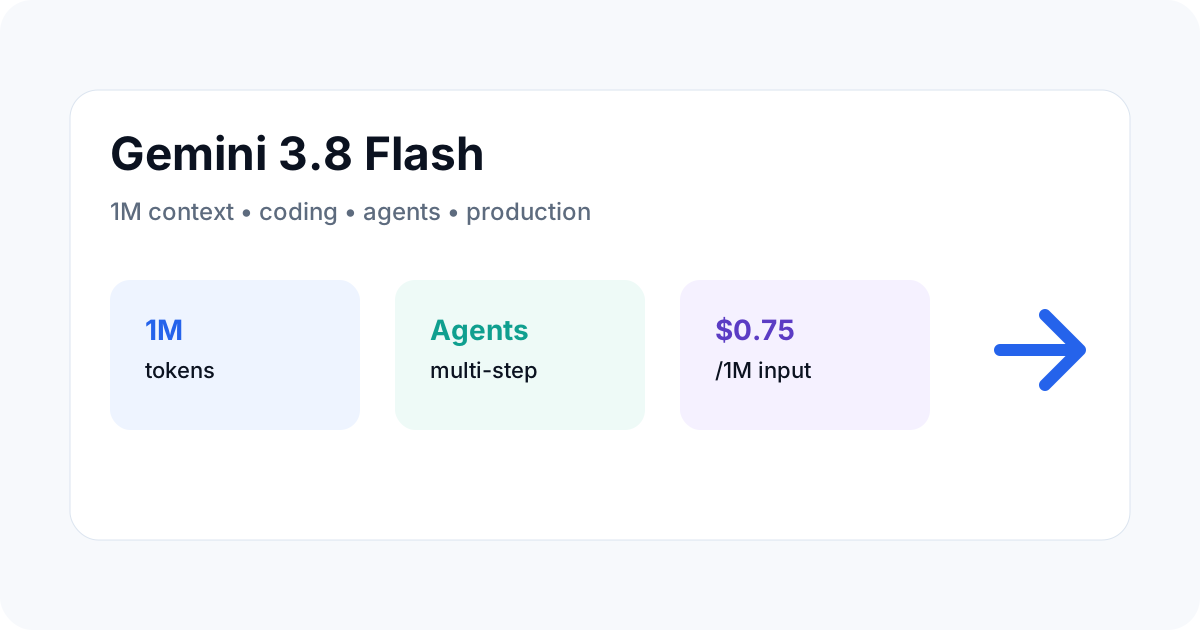
What changed with Gemini 3.8 Flash
The main change is not simply a new model number. Google positions 3.8 Flash as a workhorse model for tasks that run over multiple steps. Its current developer documentation highlights long-horizon software engineering, autonomous agents and complex enterprise workflows.
The model is available as gemini-3.8-flash. Google describes it as generally available and says it supports the same broad family of built-in tools used by its current agent stack.
Gemini 3.8 Flash pricing
The introductory API price is $0.75 per million input tokens and $3.75 per million output tokens through the end of 2026. Google says standard pricing becomes $1.50 per million input tokens and $7.50 per million output tokens on January 1, 2027. That future price matters for teams that are building a workflow expected to run for months.
Price alone is not enough to select a model. A lower token bill can still be expensive if the model needs more retries, longer prompts or extra tool calls to finish the same job.
How the 1 million token context changes workflow design
Gemini 3.8 Flash supports a 1 million token context window and up to 64,000 output tokens. For large repository work, long research packets, product catalogs or multi-document analysis, that can reduce the need to split work into many independent prompts.
Large context does not mean every task should be placed into one giant prompt. Keeping source material organized still matters. A better workflow separates instructions, trusted source material, task state and output requirements.
What the model adds for software engineering
Google highlights complex multi-file refactoring and deterministic tool execution. In practical terms, that makes 3.8 Flash more relevant for repository tasks where an agent needs to understand several files, make connected changes and continue through a sequence instead of answering one coding question.
Teams should still require tests, version control and review. A model that can make more changes in one run can also introduce a larger error surface when the instructions are weak.
Gemini 3.8 Flash for AI agents
The developer documentation says the model is designed for autonomous agents and multi-step planning. Google also says it is the default model for managed agents in its Antigravity agent stack.
For agent builders, the useful pattern is to treat the model as one component of a controlled system. Tool permissions, timeouts, state, human approval and logging should remain outside the model itself.
What Gemini 3.8 Flash is good for
| Workload | Why it fits |
|---|---|
| Large code changes | Long context and multi-file reasoning |
| Agent workflows | Planning and tool orchestration |
| Enterprise analysis | Long documents and structured outputs |
| Repeated production calls | Flash pricing and general availability |
What to test before using it in production
Start with representative tasks rather than benchmark screenshots. Measure task completion, retries, latency, token use, tool-call failures and the amount of human correction required.
For coding, include multi-file changes, failed tests and rollback scenarios. For agents, include permission boundaries and a case where a required tool is unavailable. For business workflows, compare the total cost of successful completion rather than raw token price.
Gemini 3.8 Flash vs an older model
Migration makes the most sense when the new model removes a real bottleneck. A larger context window may simplify prompt assembly. Better tool execution may reduce retries. Stronger reasoning may reduce human review. But teams should measure those gains on their own workload.
Also check model IDs and pricing in Google's current API documentation before hard-coding them into an application. Model availability and pricing can change, and the introduction price is explicitly temporary.
Common mistakes when evaluating Gemini 3.8 Flash
One common mistake is comparing models only on a single benchmark. Another is assuming that a 1 million token context means the model will use every document equally well. A third is ignoring the cost of tool calls, retries and orchestration around the model.
A stronger evaluation starts with ten to twenty real tasks, defines success before testing, and records both successful and failed runs. Keep a fixed test set so future model changes can be compared fairly.
Related ToolBoxKart guides
For Gemini workflows, read How to Build a Gemini Gem for SEO Content and the Gemini Windows app guide. For cross-model coding choices, see Claude vs ChatGPT vs Gemini for SEO and Coding. For agent architecture and permissions, use the AI Agent Architect guide.
Frequently asked questions
Is Gemini 3.8 Flash generally available?
Google's developer documentation says Gemini 3.8 Flash is generally available through the Gemini API.
What is Gemini 3.8 Flash pricing?
The introductory price is $0.75 per million input tokens and $3.75 per million output tokens through December 31, 2026. Google's documentation lists higher standard pricing from January 1, 2027.
How large is the context window?
The current developer documentation lists a 1 million token context window and a maximum output size of 64,000 tokens.
Sources
- Google — Gemini 3.8 Flash and 3.8 Flash Cyber
- Google AI for Developers — What's new in Gemini 3.8 Flash