OpenAI announced on October 21, 2026 that ChatGPT Ads are expanding to 26 additional countries, bringing stated availability to 89 countries. The company says ads appear on Free and Go plans, while Plus, Pro and Enterprise remain ad-free. For marketers, the expansion creates another paid discovery channel, but the announcement does not replace the need to confirm account eligibility, partner access, campaign objectives and measurement options in each market.
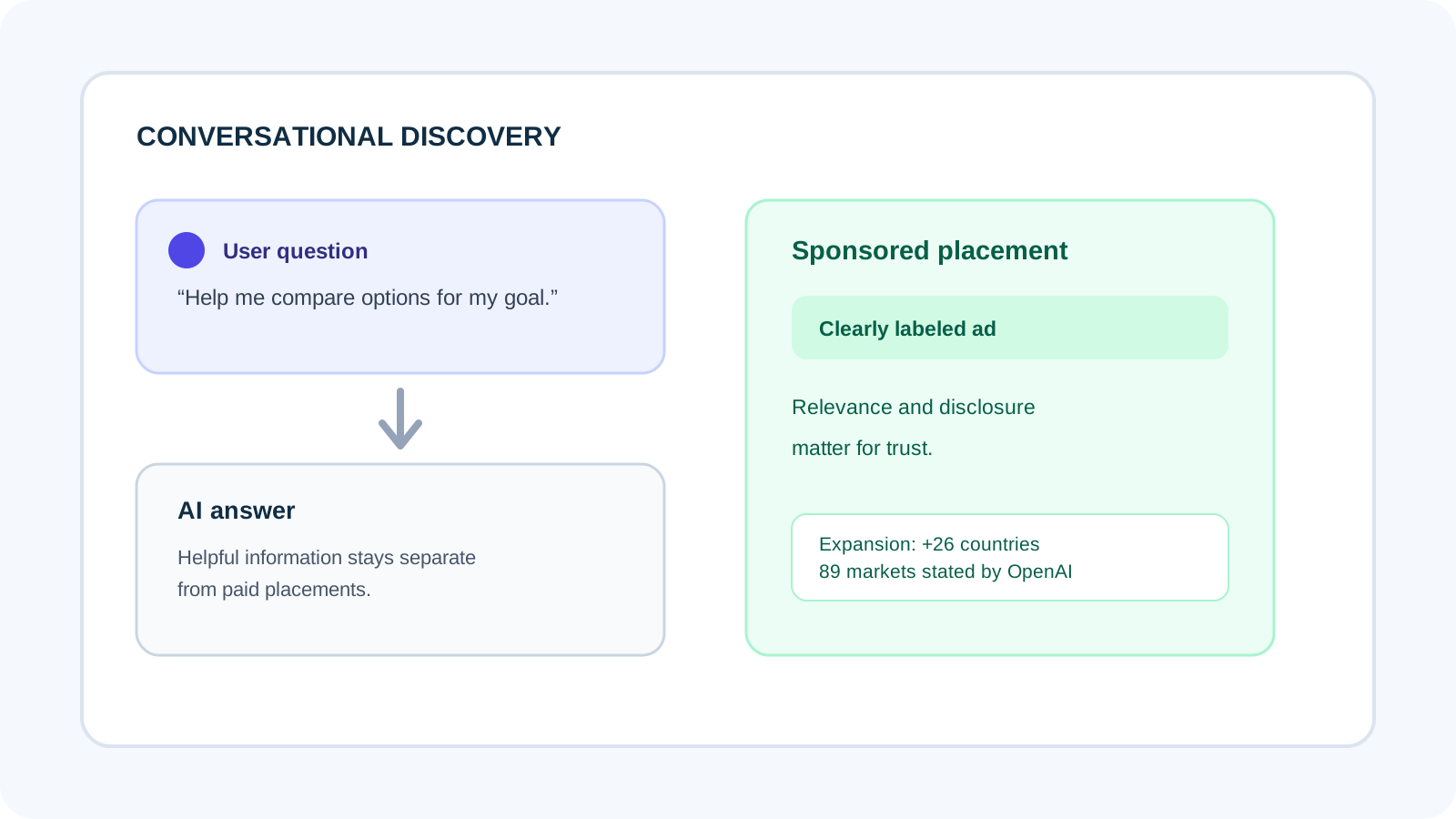
What changed on October 21
OpenAI says the expansion adds 26 countries and extends advertiser access to 89 markets worldwide. Access may depend on local availability and the route used to buy campaigns.
Which markets are included, and how can advertisers join?
OpenAI says the expansion includes 14 additional Latin American countries following launches in Mexico and Brazil, alongside markets in Europe, the Middle East, Africa and Asia. The company names Argentina, Chile, Colombia, Peru, Nigeria, South Africa, Serbia, Ukraine, Cambodia, Bangladesh and Pakistan among the examples. Its announcement says advertisers can access ChatGPT Ads through technology partners or self-service access in Ads Manager, but it does not mean every account will see the same buying route on day one.
Before adding the channel to a media plan, confirm that the target country is enabled for your account, the intended billing entity can buy campaigns, and the available targeting, creative formats and objectives fit the campaign. Do not assume a country expansion automatically means all language, category or audience options are supported.
The announced total of 89 countries is OpenAI's availability figure as of October 21, 2026. Treat it as a dated product statement and re-check the advertiser documentation before launching campaigns in a new market.
How marketers should measure a conversational ad channel
ChatGPT is used for multi-turn exploration, so the path from an ad impression to a purchase may not look like a conventional search-ad click. OpenAI describes the context as people explaining what they need, asking follow-up questions and refining their options. That can create a different discovery moment, but it does not guarantee that an impression is more valuable or more likely to convert.
Build a measurement plan before spending. Define the business outcome first, such as qualified leads, completed purchases or incremental demand. Track the available campaign-level metrics, use consistent conversion definitions, and compare results with a relevant baseline. If the platform provides limited placement-level data, state that limitation rather than filling the gap with a guessed attribution model.
For a fair test, separate the new channel from changes in offer, creative, landing page and seasonality. Set a budget cap and a review date. Compare cost per qualified outcome and downstream value where measurement is reliable, not just reach or click-through rate. If an experiment cannot isolate the effect of the ads, treat its result as directional rather than proof of incremental lift.
What OpenAI says about privacy and answer independence
OpenAI says conversations remain private from advertisers, that it does not sell customer data, and that ads are clearly labeled and separate from ChatGPT's answers. It also says advertising does not influence the answers ChatGPT provides. These are important product commitments, but advertisers should treat them as OpenAI's stated policy and read the current terms and help documentation before making claims to customers.
For brands, clear separation matters because users may interpret a conversational recommendation as an answer rather than an ad. Campaign teams should review how sponsored placements are labeled, what information is available to advertisers, and what data the advertiser itself collects after a user follows a link. The privacy of a conversation does not remove the advertiser's own duties around consent, tracking, retention and data protection on its website.
Do not ask customers to share sensitive personal information in ad creative or use a conversational placement as a substitute for a privacy review. Make the destination page transparent about the product, the business behind it, and what happens when a visitor submits a form or completes a purchase.
A launch checklist for brands
Use a short readiness check before committing budget to a new country:
- Confirm country, account and billing eligibility in the current Ads Manager documentation.
- Check whether your category, landing page and creative meet the platform's current requirements.
- Set one primary conversion and document how it is measured.
- Make sure landing pages load well on mobile and explain price, eligibility and next steps clearly.
- Set a test budget, a minimum observation period and a decision rule before the campaign starts.
- Review actual results and quality of leads or sales, not only top-of-funnel activity.
Do not scale solely because the channel is new or because the potential audience is large. Compare it with the channels that already reach the same customers, and keep a record of what the test can and cannot establish.
What remains unknown
The expansion announcement does not provide a complete country-by-country feature matrix, universal pricing details or a guarantee that every advertiser can self-serve immediately. OpenAI says it plans to add formats, objectives, buying options and measurement capabilities over time. Those are future plans, so teams should confirm the current product rather than build forecasts around features that have not launched.
Plan for a discovery journey, not just a keyword list
Conversational discovery can start with a broad need and narrow through several follow-up questions. That makes the user journey different from a single query followed by a list of search results. Advertisers should map the questions customers ask before choosing a product, then check whether their landing pages answer those questions clearly. The goal is to help a visitor make a decision, not to force a generic ad message into every conversation.
Do not assume that a ChatGPT placement replaces search ads, shopping listings or social campaigns. Treat it as a channel to test against a defined audience and business outcome. Compare the quality of resulting visits or leads with the channels that serve the same audience, and watch for differences in conversion lag or assisted conversions where the available data supports that analysis.
OpenAI's announcement says more formats, objectives, buying options and measurement capabilities are planned. Until those options are documented and available to your account, build plans around the controls that exist today rather than promised future capabilities.
Related ToolBoxKart guides
For a wider view of discovery beyond a single search click, read our guide to measuring zero-click search visibility. If your team is already testing ads across marketplaces, this overview of ChatGPT and Amazon Ads marketing workflows offers a useful comparison point for campaign planning.