What is Hy4 preview?
Tencent released Hy4 preview on August 28 as the next generation of its Hunyuan open-model line. The model is designed around practical work rather than only benchmark performance, with training and evaluation focused on software engineering, office and analysis tasks, game development and scientific research. citeturn942174search1turn806241search0
Key specifications
| Specification | Hy4 preview |
|---|---|
| Architecture | Mixture of Experts |
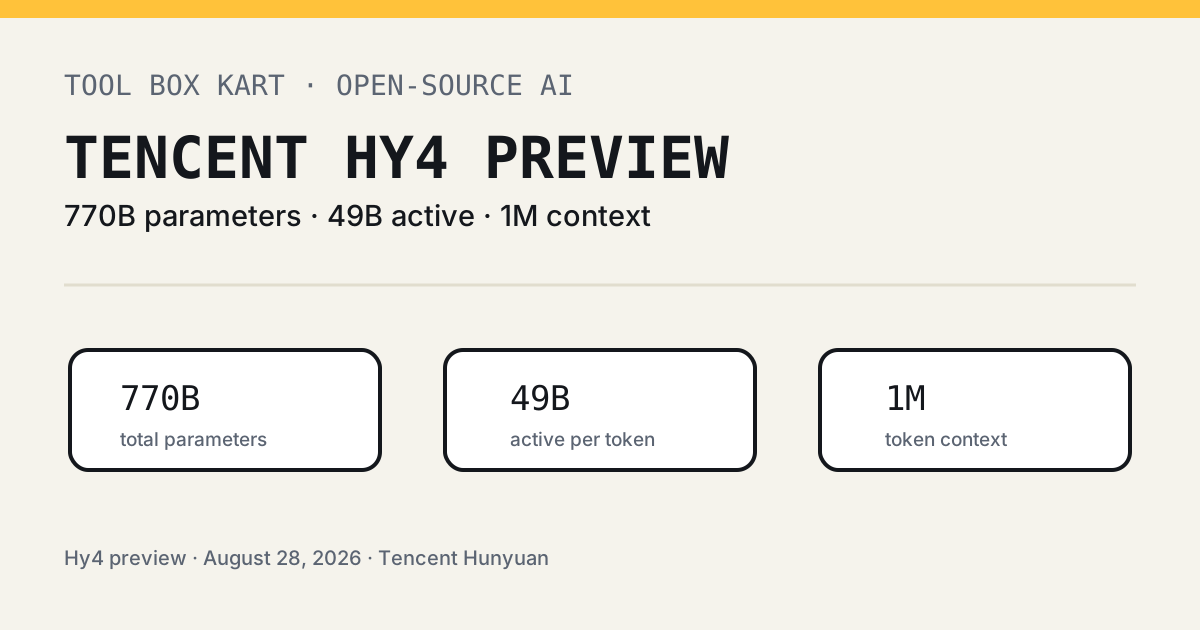
| Total parameters | 770B |
| Active parameters per token | 49B |
| Layers | 78 |
| Context length | 1M tokens |
| Routed experts | 256 |
| Active routed experts per token | 8, plus 1 shared expert |
| License | Apache 2.0 |
Tencent's technical repository says the backbone uses one dense layer and 77 MoE layers. It also uses Gated DeepSeek Sparse Attention with IndexCache and includes a native multi-token prediction layer to support speculative decoding. citeturn806241search0
Why the 1M context matters
A 1M-token context window can be useful when a task depends on a very large amount of related material, such as a long codebase, many technical documents, or large collections of business files. It allows more context to stay in a single model interaction.
But a larger context window does not automatically mean better answers. Hy4 preview is still an early release, and Tencent lists longer-than-necessary reasoning and over-verification among its known limitations. citeturn806241search0
What Tencent's evaluation shows
Tencent says 163 internal experts evaluated Hy4 preview on 203 engineering tasks in a blind side-by-side test. The model scored 2.99 out of 4, compared with 2.92 for GLM 5.3 and 2.94 for Kimi K3. The result was a Tencent-run evaluation, so it should be treated as a company-reported result rather than an independent benchmark. citeturn806241search2turn806241search0
That detail is still useful because the evaluation was built around real engineering tasks rather than a single public benchmark. Tencent's broader goal is to optimize Hy4 for the work its product teams and internal experts actually perform.
How developers can use it
Hy4 preview is open-source and available through Tencent's model repositories. The official project provides deployment instructions for vLLM and SGLang and documents an OpenAI-compatible serving interface. Tencent also says developers can access the model through WorkBuddy, CodeBuddy, Tencent Cloud TokenHub and OpenRouter. citeturn806241search0turn942174search1
The practical challenge is hardware. A 770B-class model is not a casual laptop deployment. The FP8 version and optimized serving stacks can make deployment more practical, but teams still need to evaluate memory, throughput, latency and infrastructure cost before choosing self-hosting.
For keeping technical content current when model versions change, ToolboxKart's Content Freshness Checker is a useful companion tool.
Known limitations
- Hy4 preview is an early version, not the final Hy4 model.
- Tencent says it can spend too long reasoning through complex tasks.
- The model can over-verify its own work.
- Its headline evaluation results are mainly vendor-reported.
- Self-hosting requires substantial compute resources.
Why this release matters
The interesting part of Hy4 is not simply the 770B headline. The model combines sparse activation, a 1M context window, open weights, deployment support, and a stated focus on agentic productivity work.
That expands the set of serious open-model choices available to developers. Teams can compare it against closed APIs and other open models using the factors that matter to their own workloads: coding quality, context handling, inference cost, latency, licensing and deployment control.
It also fits into a wider agent trend. As models become better at planning, tool use and long-running tasks, the model itself becomes one layer in a larger software system. ToolboxKart's Physical AI analysis covers the next step of that trend, where agents can interact with physical equipment.
What to watch next
The next useful signals are independent evaluations, community deployment results, inference cost, hardware compatibility and how often developers use Hy4 outside Tencent's own products.
Tencent has also been iterating quickly across the Hy series. The key question is whether the large-context and agent capabilities of Hy4 can translate into a stable, cost-effective option for real production workloads.
Bottom line
Hy4 preview is an important open-source release because it puts a 770B MoE model with a 1M-token context window into developers' hands. Its internal 163-expert evaluation suggests a focus on real engineering tasks, while its known limitations show that this is still an early model.
For developers, the value is choice. Hy4 adds another serious option for teams that want long context, open weights and control over deployment without limiting the model to small-scale workloads.