Z.ai Releases GLM-5.3 Weights: What Developers Need to Know

What changed with the GLM-5.3 release?
What does open-weight mean for GLM-5.3?
What does GLM-5.3 improve over GLM-5.2?
Why does the two-week release delay matter?
What can developers use GLM-5.3 for?
What is the biggest trade-off with the open release?
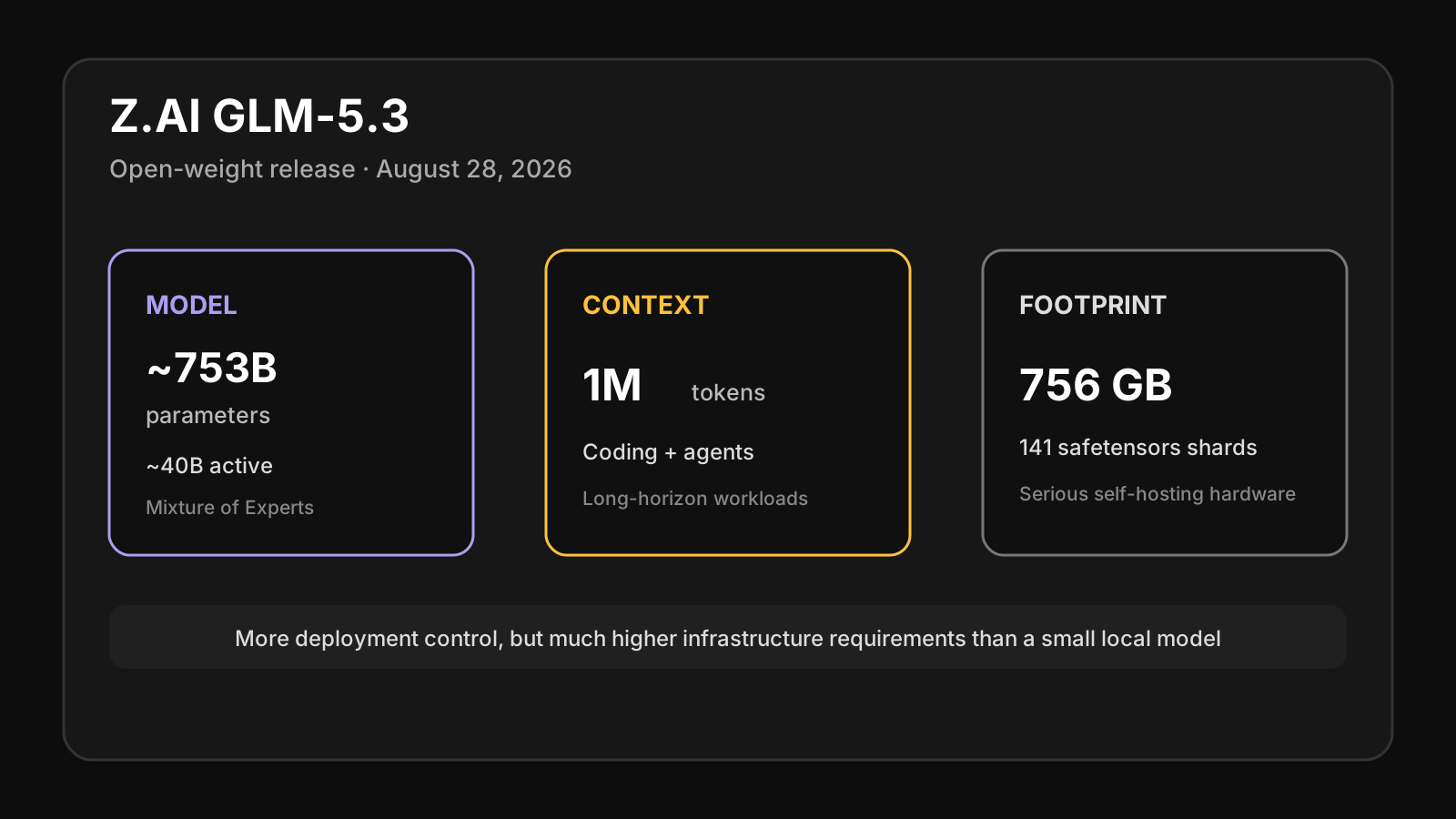
Z.ai released the GLM-5.3 model weights on August 28, 2026, about two weeks after its initial model launch. The release moves GLM-5.3 from an API-first model to a model developers can download and run themselves.
The practical issue is scale. The Hugging Face repository lists a 756 GB model footprint, so “open-weight” does not mean easy local use on normal consumer hardware.
What changed with the GLM-5.3 release?
Z.ai first launched GLM-5.3 on August 14 as a coding and agentic model. The company said it would release the weights after additional safety work.
The public Z.ai GLM-5.3 repository on Hugging Face is now available. The repository includes model files, configuration, inference instructions, and a dedicated GLM-5.3 license.
What does open-weight mean for GLM-5.3?
Open-weight means developers can obtain the model parameters and run the model outside Z.ai's hosted service. It does not mean the model has a standard open-source software license.
The repository names the license “glm-5.3.” The license grants broad rights to use, modify, deploy, fine-tune, publish, distribute, and sell the software, subject to its stated conditions.
That distinction matters for commercial teams. Read the license itself before building a product around the model rather than assuming “open-weight” means every use case has no restrictions.
How large is GLM-5.3?
The current Hugging Face repository lists a 756 GB model repository. It contains 141 safetensors shards, each around 5.36 GB.
That size changes the deployment question. Downloading the model, storing it, loading it into memory, and serving it at useful speed all require serious infrastructure.
Can a normal laptop run GLM-5.3?
Not as a practical full-model deployment. A laptop usually does not have enough memory to hold a model of this size at usable precision.
Quantization can reduce memory needs, but it does not make a model this large equivalent to a small local model. Developers still need to test quality, latency, memory use, and throughput after quantization.
What does GLM-5.3 improve over GLM-5.2?
Z.ai says GLM-5.3 uses the same base model as GLM-5.2. The reported gains come from additional post-training rather than a new pre-training run.
On Z.ai's own Code Bench, the company reports a 50% improvement over GLM-5.2. It also reports gains on public coding and agent benchmarks.
Which benchmark results stand out?
On Terminal-Bench 2.1, Z.ai reports a rise from 81.0 for GLM-5.2 to 88.2 for GLM-5.3. On Terminal-Bench 3.0, the reported score rises from 4.6 to 28.3.
DeepSWE also rises from 46.2 to 66.9 in Z.ai's published comparison. These figures come from Z.ai, so independent testing still matters before using the scores as a buying decision.
Why does the two-week release delay matter?
Z.ai did not publish the weights on the same day as the August 14 model launch. The company said it would complete security enhancements and safety evaluations first.
That staged release gives developers a useful signal about how open-weight model labs can balance access with added review. It also shows that open release timing can depend on model capability, not just engineering readiness.
What can developers use GLM-5.3 for?
Z.ai positions GLM-5.3 for complex coding, long-horizon tasks, agentic workflows, and cybersecurity work. The Hugging Face repository also provides instructions for Transformers, vLLM, SGLang, and Docker-based use.
Developers can test the model against coding agents, software repositories, research tasks, and tool-driven workflows. The right evaluation depends on the workload rather than a single leaderboard score.
What should teams measure?
Measure task success, latency, token throughput, memory use, failure recovery, and operating cost. For agent workflows, track tool-call success and how often humans must correct the model.
For security use cases, add clear safeguards and keep the model inside an approved environment. Strong benchmark scores do not remove the need for access controls or monitoring.
What is the biggest trade-off with the open release?
The biggest trade-off is control versus infrastructure cost. Self-hosting gives developers more control over deployment and data flow, but the hardware and operations burden move to the user.
Hosted inference can be easier for teams that need quick access. Self-hosting makes more sense when control, customization, private data, or predictable infrastructure economics matter enough to justify the cost.
What does this release mean for AI and SEO teams?
AI teams now have another large open-weight model to test in private workflows. SEO teams can also use local models for content analysis, clustering, site audits, and research without sending every document to a third-party API.
That does not replace public AI Search measurement. A private model may change how a company analyzes its own content, while Google AI Search controls how public web pages appear in search features.
For structured content work, the Article Schema Generator can create article JSON-LD. The Canonical Checker can verify the preferred URL before a page goes live.
Tool Box Kart also tracks other large open models, including the Tencent Hy4 preview. Comparing deployment size and actual workloads gives a better view than parameter count alone.
What should developers check before deploying GLM-5.3?
Start with the license, hardware plan, inference framework, quantization format, context needs, and expected traffic. Then run a controlled test on your own workload.
Use the model's official repository for current files and serving instructions. Recheck the repository before deployment because model files, instructions, and community evaluations can change after release.
Z.ai GLM-5.3 Open Weights FAQ
When did Z.ai release GLM-5.3 weights?
Z.ai released the GLM-5.3 weights on August 28, 2026. The model first launched on August 14, followed by a staged open-weight release.
What license does GLM-5.3 use?
The official Hugging Face repository lists a dedicated “glm-5.3” license. Developers should read its conditions before commercial deployment.
How large is the GLM-5.3 model repository?
The Hugging Face repository currently lists about 756 GB and 141 safetensors model shards.
Is GLM-5.3 easy to run on a personal computer?
No. The full model requires substantial memory and storage. Quantized variants can reduce requirements, but developers still need suitable hardware and testing.
Are the GLM-5.3 benchmark scores independent?
No. The headline comparisons on the official model page come from Z.ai. Independent evaluations can provide a separate view of real-world performance.
Written by Deepak Parmar
Deepak Parmar is an SEO and AI-search specialist focused on technical SEO, content strategy, and search visibility.
He writes practical guides on Google Search, AI Search, AI tools, technology, and digital workflows.
Sources
Related on Tool Box Kart: Tencent Hy4 Preview and Article Schema Generator.