Optimizing for Google's AI search features is less about adding an “AI SEO” trick and more about making a page clear, useful, crawlable and easy to understand. Google's 2026 Search updates also put more focus on original content and trusted sources, so the safest approach is to improve the page for people first and then make the important information easy for search systems to retrieve.
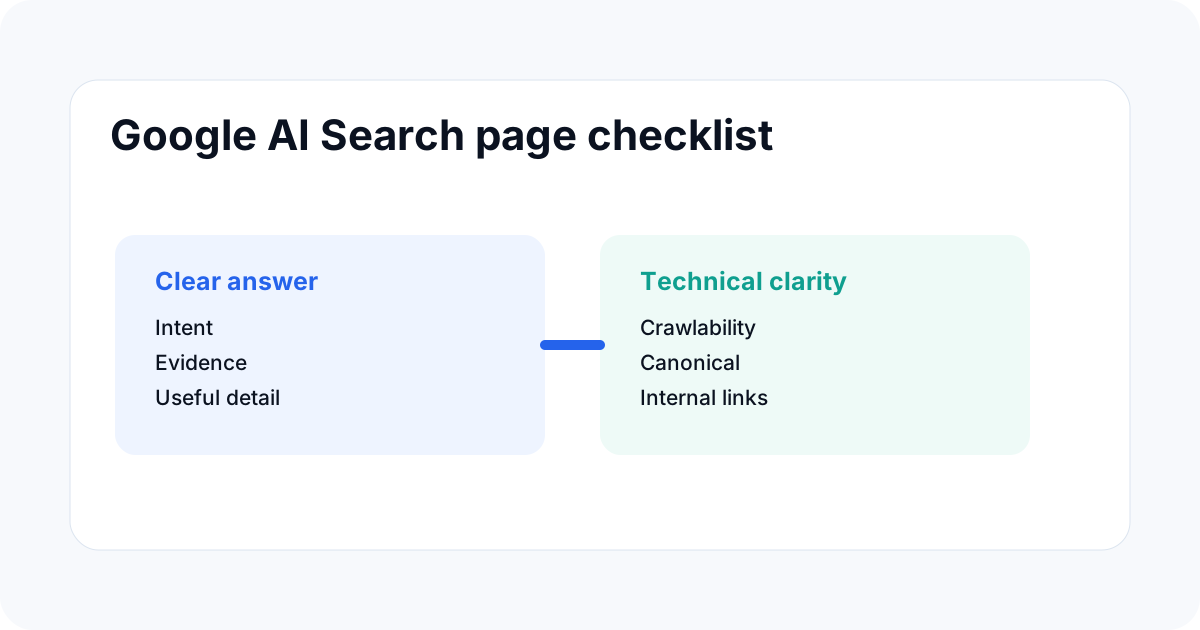
What Google AI search needs from a page
AI Overviews and AI Mode can use information from web pages to build answers and provide links. That makes page clarity important. A page should explain the topic directly, support claims with evidence, and keep important facts visible in HTML rather than hiding them behind unnecessary interaction.
Google's own guidance also points toward original, high-quality content and ways for users to find preferred sources. There is no single switch that guarantees inclusion in an AI answer.
Start with the search intent
Before changing a page, define the actual question. A page targeting “how to fix broken canonical tags” should solve that problem rather than turning into a broad article about technical SEO.
Write the direct answer early. Then support it with the checks, examples, exceptions and next steps a reader needs. This creates a page that is useful whether the visitor arrives from a classic result, an AI answer or a shared link.
Make the main answer easy to extract
Use a clear H1 and descriptive H2 headings. Put important definitions, steps and comparisons in normal text. Use tables when they make a decision easier. Avoid forcing readers to click through five tabs just to find the core information.
ToolBoxKart's existing AI search visibility guide can help with the measurement side, while this workflow focuses on the page itself.
Show evidence and source quality
For factual claims, link to primary sources where possible. For technical recommendations, explain the basis for the recommendation. For company claims, label them as company claims instead of presenting them as independent proof.
Google has also described features that help users discover original content and preferred sources in AI Search. That makes source transparency a useful part of a publisher's page design.
Build information gain instead of a summary
A page that only repeats a press release has little reason to outrank or support better content. Add something useful: a before-and-after table, implementation checklist, tested example when you actually tested it, or a clear comparison of options.
Do not invent tests. If you did not run a crawl, speed test or experiment, do not write that you did. Use verified documentation and explain what follows from it.
Use structured data carefully
Structured data can help search systems understand eligible content types, but it should match the visible page. Do not add schema simply because it contains a keyword. Keep required fields accurate, use the correct canonical URL and avoid duplicate structured data already produced by a shared template.
Structured data also does not guarantee an AI citation or a rich result. It is one part of the page's technical signal set.
Improve internal linking
AI search does not remove the value of a clear site structure. Link from a guide to related tools, definitions, supporting articles and deeper explanations when they genuinely help. Use natural anchors that tell the reader what the destination contains.
On ToolBoxKart, an article about AI search should connect to the existing AI visibility report and relevant Search Console guides rather than building a disconnected cluster of one-off pages.
Do not over-optimize for AI phrases
Writing “AI SEO keywords” into every paragraph does not create useful content. Avoid repetitive phrases such as “for AI search” when they add no meaning. The page should remain readable if every reference to AI search is removed.
Focus on the user's task, clear structure, supporting evidence and complete coverage of the question. Those choices are easier to maintain as search interfaces change.
Measure outcomes correctly
Track impressions, clicks, query groups and page-level performance in Search Console. Where you have reliable analytics, connect traffic to engaged sessions and business actions. Keep in mind that Search Console data and AI reporting may represent sampled or evolving views of Search behavior.
Do not create an “AI visibility score” with arbitrary weights. A simple report with clearly defined metrics is more useful than a precise-looking number that cannot be audited.
Page optimization checklist
- State the direct answer near the top.
- Use descriptive headings that match real questions.
- Add primary sources to important factual claims.
- Include one or more useful information-gain elements.
- Check internal links and canonical URLs.
- Keep structured data aligned with visible content.
- Review the page on mobile.
- Measure Search Console and business outcomes after publishing.
Related ToolBoxKart guides
For AI-search measurement, read the Google AI Search Visibility Report and Search Console AI Performance Report Guide. For regional differences, see Google Regional Search Experience: What Changed. For content strategy, read SEO Content Refresh vs New Page.
Frequently asked questions
Can any page be guaranteed a place in Google AI answers?
No. Google does not provide a setting that guarantees inclusion in AI Overviews or AI Mode.
Should I add special AI keywords to my pages?
Usually no. Write for the real search intent and make the useful information clear. Avoid repetitive AI-focused wording that does not help the reader.
Do I need structured data for AI search?
Structured data can help search systems understand eligible content, but it is not a guarantee of AI visibility. Use the types that match the visible page and Google's requirements.
Sources
- Google — New ways to find favorite sources and original content in AI Search
- Google — 5 new ways to explore the web with generative AI in Search
- Google Search Central — Canonicalization guidance