OpenAI, PerturbAI and Scripps Research reported on October 21, 2026 that thousands of GPT-Rosalind-powered AI agents analyzed existing experimental data from millions of mouse brain cells in 32 minutes. The system connected gene-disruption results with scientific literature to produce leads for scientists to investigate. This is a research workflow demonstration, not proof of a new treatment: the proposed biological explanations still need follow-up experiments.
What the research team reported
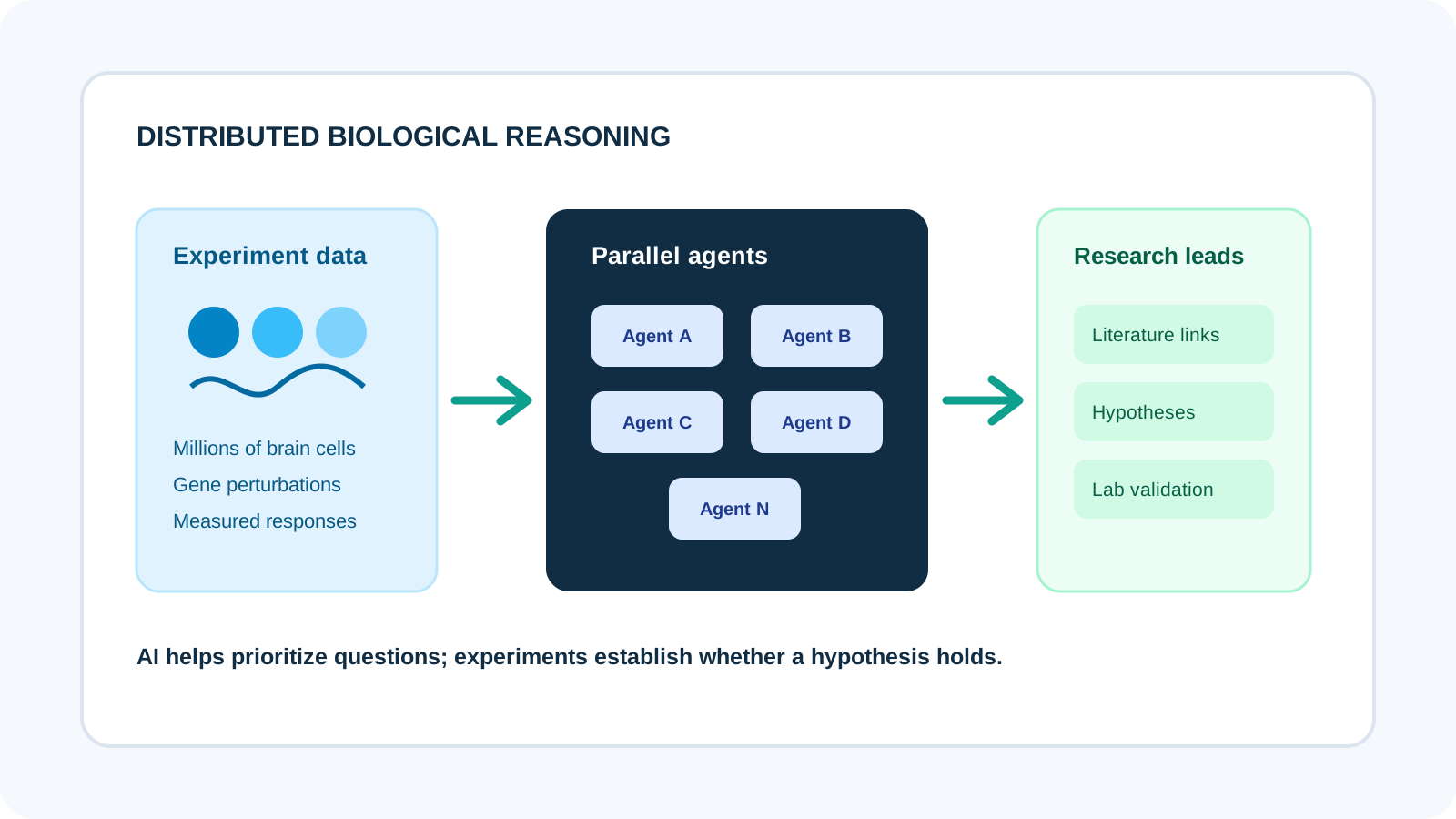
The work applies separate agents to individual perturbations in a whole-brain CRISPR atlas, then combines the reports into a reasoning atlas that links genes, cell effects, publications and possible mechanisms.
How the distributed workflow divides the research
The team describes assigning separate agents to individual gene disruptions in a whole-brain CRISPR atlas. Each agent examines a perturbation, reviews cellular responses, searches scientific literature and proposes an explanation. Those separate reports are then combined into a reasoning atlas that links genes, observed cell effects, publications and possible mechanisms.
This design addresses a practical bottleneck in large experiments. A dataset may contain thousands of perturbations and measurements across many cell types, while the literature needed to interpret those results spans many papers and disciplines. A single researcher cannot review every combination in the same depth within a short period. Parallel agents can widen the search, then give scientists a structured set of connections to inspect.
The system does not remove the need for domain expertise. The value depends on whether the underlying data are suitable, the cited papers actually support the claims, and the proposed explanation fits what is known about the biology. A generated research map is a way to prioritize questions, not a substitute for a validated scientific conclusion.
Which findings did the agents surface?
OpenAI's account describes a difference between disrupting Tsc1 and Tsc2, two genes involved in regulating mTOR. The effects were similar in some neuron groups, but the report says Tsc2 disruption changed the activity of many genes involved in neuronal communication in the cerebellum, while Tsc1 disruption produced little change there. The team connects that pattern with existing knowledge about tuberous sclerosis, while presenting it as a lead for follow-up work.
A second example concerns DCTN1, a gene associated with Perry syndrome. The agents connected a change in gene expression after Dctn1 disruption with research about cholesterol production and transport. That raises questions about how cholesterol is distributed inside neurons and whether the effect contributes to neurodegeneration. It does not establish a causal mechanism or show that changing cholesterol would treat the disease.
These examples show the role of the output: connect a measured result with prior research, identify a plausible explanation and make the next experiment more specific. The scientific value lies in the question it helps a lab test, not in a claim that the model has discovered a cure.
What the comparison says about parallel agents
The OpenAI post reports that a distributed system produced more extensive literature coverage than a single-agent setup when the team kept the model and resources fixed. At the largest workload, the distributed agents cited more than 700 references, while the single agent cited 11. In blinded comparisons, human experts preferred the distributed-agent reports 75% of the time.
Those figures describe this research setup and the company's reported evaluation. They should not be read as a universal benchmark showing that more agents always produce better research. The outcome depends on the question, dataset, literature access, how the agents are divided, how duplicate or conflicting claims are handled, and how experts judge the final report.
The team also estimated that comparable human analysis, performed one perturbation at a time, could take months to a year. That is an estimate from the research team, not a measured head-to-head study of every possible human workflow. It is useful as context for the scale of the task, but not as a general productivity multiplier for all scientific research.
How researchers should validate an AI-generated lead
Researchers considering a similar workflow should keep the analysis traceable. Each proposed connection should point to the source data, the relevant paper and the exact claim being made. A citation list alone is not enough: a reviewer needs to confirm that the paper supports the claim and that the claim fits the experimental context.
- Check the underlying dataset, cell types, perturbation definitions and quality filters.
- Review citations and distinguish direct evidence from an agent's interpretation.
- Ask an independent researcher to assess novelty and biological plausibility.
- Rank hypotheses by testability, not only by how convincing the written explanation sounds.
- Design a follow-up experiment with a clear outcome that could disconfirm the hypothesis.
Scientists should also document model versions, prompts, retrieval sources and any manual edits. This makes it possible to reproduce a finding or understand why two runs produced different explanations. For biomedical research, an AI-generated hypothesis should not be presented as clinical guidance or evidence of treatment effectiveness.
Limits that remain before scientific use
The published workflow starts from existing experimental data and produces candidate explanations. It does not replace the original experiment, prove that a mechanism is causal, or show that a proposed treatment will work in people. Mouse-brain data may point toward a useful question, but translation to human disease involves additional evidence and often years of research.
There are also technical limits. Agents can miss relevant papers, overstate a weak connection, misread a result or repeat the same unsupported assumption across multiple reports. Parallel execution can increase coverage, but it also increases the need for source tracking, duplicate detection and quality review. Human expert review is part of the workflow, not an optional finishing step.
The strongest use case is a research team that already has a well-defined dataset and enough expertise to judge the results. AI can help prioritize the next question and make a large search space easier to explore. The lab still needs to run the experiment, measure the outcome and update its understanding when the evidence disagrees with the model's suggestion.
Can other scientists inspect the work?
The team has published a public Distributed Agents repository and linked the research preprint. The repository describes a framework for scaling biological interpretation across large perturbation screens, with reports that connect cell-level results to literature. That public material gives researchers a starting point for inspecting the approach and understanding how the analysis was organized.
Reproducibility still depends on the specific corpus, data releases, environment and analysis settings. A public repository does not automatically mean every dataset can be reproduced with a hosted interface, and the repository notes that its hosted experience differs from running the full analysis locally. Researchers should read the project's setup and data notes before assuming they can reproduce the full manuscript from a browser alone.
For any follow-up study, record the dataset version, preprocessing steps, model and prompt settings, retrieved literature, and the human review process. These details make it easier to separate a repeatable finding from a plausible explanation that emerged in one run.
Related ToolBoxKart guides
Teams building agent-based research workflows may also find our guide to evaluating AI agents end to end useful. It covers system-level checks that complement the human review and evidence validation needed for scientific analysis.
Sources
- OpenAI: Using thousands of AI agents to uncover new leads in biological data
- Distributed Agents research repository
- Sun et al.: Distributed AI agents enable comprehensive discovery of biological insights at scale