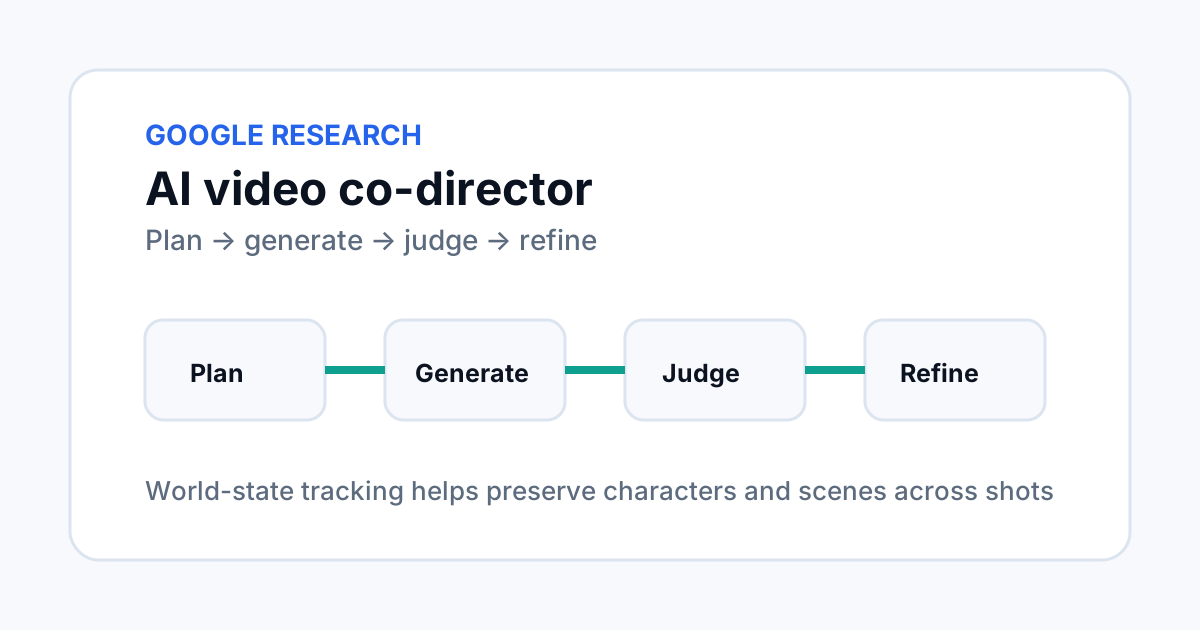
Google Research has introduced a multi-agent framework for generating long-form video narratives with better visual continuity across many shots. The research is built on Gemini and Veo and is designed to address two common problems in automated video pipelines: semantic drift, where characters or settings change over time, and cascading failures, where an early mistake damages later shots.
Why long-form AI video is harder than short clips
Modern video models can produce impressive individual clips, but a longer narrative has to preserve more than image quality. Characters need to stay recognizable, locations need to remain consistent, objects should not change shape without a reason, and the story must continue rather than collapse into repeated scenes.
Google Research says many existing agent pipelines chain independent modules together. That can create a weak link: if an early asset is wrong, later stages may inherit the error without understanding where it started.
The co-director treats continuity as a system problem
The new framework treats long-form generation as a global optimization and world-state tracking problem. Instead of asking each stage to solve continuity independently, the system keeps information about the evolving story and feeds evaluation results back into the workflow.
Google describes several related research frameworks under the broader co-director approach: Co-Director, CANVAS, A²RD and VQQA. Each focuses on a different part of orchestration, memory, refinement or evaluation.
What the agents do
| Agent or component | Role |
|---|---|
| Orchestrator | Chooses creative strategy, narrative direction and aesthetic decisions. |
| Pre-production | Breaks the story into a storyboard and shot plan. |
| Production agents | Generate keyframes, video and audio for individual shots. |
| Visual judge | Reviews outputs with multimodal evaluation and feeds feedback into the loop. |
The key idea is separation of responsibilities. One model is not expected to write a prompt, generate a clip, judge the clip and remember every previous state perfectly. Instead, the system gives each stage a narrower job and connects the stages with shared state and evaluation.
CANVAS adds persistent visual memory
Google describes CANVAS as a persistent visual memory system for characters, locations and object states. This gives the pipeline a place to store visual information that should remain stable across shots.
That matters because an AI video system can otherwise recreate the same entity slightly differently every time it sees a new prompt. A persistent world state gives later shots a reference instead of forcing the generator to reconstruct the visual identity from scratch.
A²RD and VQQA close the feedback loop
A²RD uses a retrieve, synthesize, refine and update cycle so the system can improve a sequence over time rather than treating each shot as final after one generation. VQQA generates visual questions about the result, evaluates what happened and helps drive another refinement pass.
This resembles software testing more than a one-shot creative prompt. The system produces an artifact, inspects it, measures a failure or inconsistency, and uses the result to guide the next attempt.
Why this architecture matters for AI workflows
The broader lesson is useful outside video. Long-running AI tasks often fail because earlier steps create hidden state that later steps cannot inspect. Adding explicit memory, specialized agents and a verification loop can make the system more resilient.
For example, the same design pattern can be used for research agents, content production, code generation or data workflows: one component plans, another executes, another evaluates, and the system records the state needed for the next step.
What Google has actually demonstrated
Google Research says the framework improved multi-shot narrative consistency and character persistence in its evaluations and successfully generated minutes-long videos while reducing visual drift and pipeline error propagation.
This is research, not a promise that the same architecture is already available as a simple consumer workflow. The research describes multiple frameworks and publications, with Co-Director planned for COLM 2026 and CANVAS planned for EMNLP 2026.
What to watch next
The interesting question is whether this kind of orchestration becomes a reusable product pattern. The value is not just higher-fidelity generation. It is the possibility of making long video generation easier to manage because continuity becomes a measurable system state instead of an informal prompt-writing task.
For another example of real-time multi-agent architecture, see our Gemini 3.8 Live Avatar guide.
Frequently asked questions
What problem is Google’s video co-director trying to solve?
It is designed to reduce semantic drift and cascading errors when an AI system generates many connected video shots.
What are CANVAS and VQQA?
CANVAS provides persistent visual memory, while VQQA is part of the evaluation and refinement loop that asks visual questions and checks generated results.
Is the AI video co-director a finished product?
No. Google Research presents it as research built around multiple frameworks, with research papers planned for conferences including COLM 2026 and EMNLP 2026.