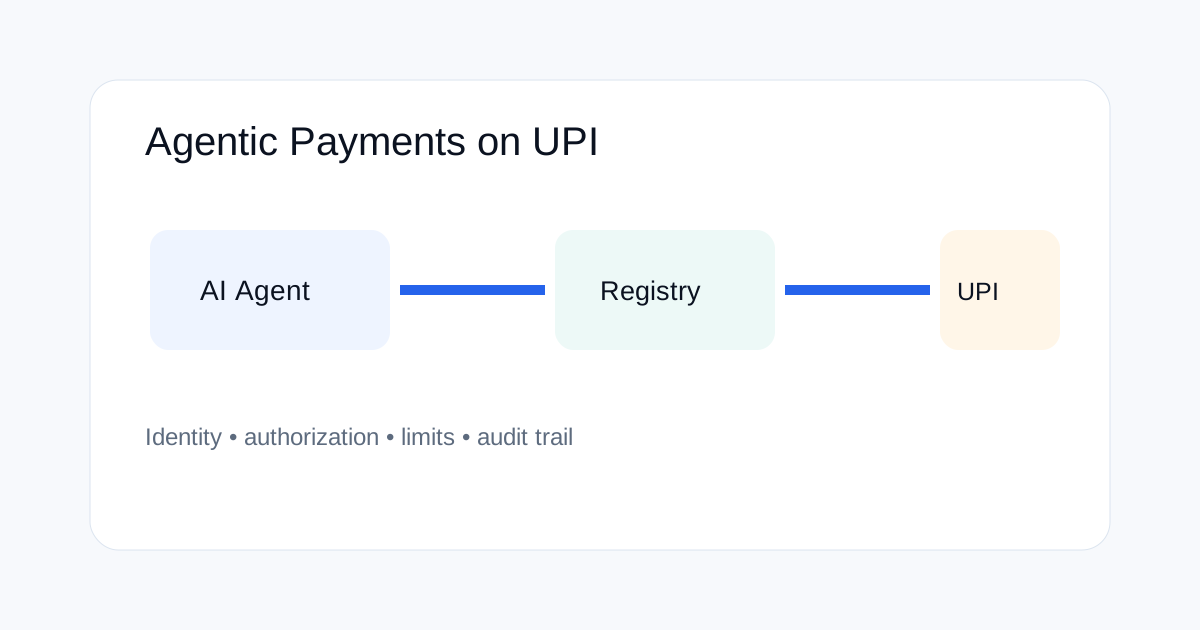
India is moving toward a system for identifying and authorizing AI agents that make payments on behalf of users. NPCI is developing a registry and a Unified Agentic Protocol for UPI, with the early focus expected to be on controlled, authenticated transactions. The change is important because it turns an AI assistant from a recommendation layer into a participant in a financial workflow.
What India is working on
Reporting from September 10 says NPCI is developing a registry to verify and monitor AI agents that conduct transactions through UPI. The work is linked to a Unified Agentic Protocol intended to make agent-initiated payments identifiable and controllable.
The exact final rules are still being developed. That means this article should be read as an update on the direction of the system, not as a statement that unrestricted agentic UPI payments are already available to everyone.
Why agentic payments are different
A normal payment requires a person or application to initiate a transaction through a known interface. An agentic payment adds an AI system that can decide when to make a transaction based on a goal and the rules given to it.
That creates new questions: which agent is authorized, what is it allowed to buy, how much can it spend, who is responsible for an error, and how can a payment be stopped or traced?
What an agent registry can solve
| Control | Purpose |
|---|---|
| Agent identity | Identify the software acting on a user's behalf |
| Authorization | Connect the agent to approved transaction permissions |
| Monitoring | Track usage and unusual transaction behavior |
| Revocation | Disable an agent or permission when risk is detected |
| Audit trail | Support investigation of disputed or unexpected payments |
Why low-value transactions make sense as a first step
Small, frequent purchases are easier to constrain than large transfers or investments. A system can start with a narrow transaction limit and require stronger approval for higher-risk actions.
This is a common safety pattern for autonomous systems: begin with a limited permission scope, observe how the system behaves, and expand only when controls are reliable.
How user consent should work
Consent should define more than a single “yes” button. A user may approve a category of actions, a spending limit, a time window or a specific merchant type.
The interface should also make it clear when a decision was made by the agent and when the user directly approved the transaction. That distinction will matter when users review their payment history.
What happens when an agent makes a mistake?
Agentic payments introduce failure modes that are different from ordinary payment errors. An agent could misunderstand a request, choose the wrong item, act on stale information or repeat a transaction after a timeout.
Systems therefore need transaction limits, confirmation policies, idempotency controls, monitoring and a clear dispute process. The agent should not be treated as an infallible payment instruction.
Why UPI is a major test case
UPI already operates at large scale, so agentic payments could have a wide impact if the model works. At the same time, that scale means safety errors could affect many users quickly. Identity and authorization therefore need to work reliably before autonomous payment features expand.
What businesses should prepare for
Merchants should think about agents as a new software client, not simply another human customer. Transaction interfaces may need to expose clear product data, payment constraints and confirmation signals that an agent can process consistently.
Businesses should also prepare for support cases where a user says an agent made an unexpected purchase. Logs need to show what agent acted, what authorization existed and what transaction rule was applied.
How AI builders should design payment agents
Keep payment execution outside the model. The model can propose an action, but a separate policy layer should validate the merchant, amount, balance, user permission and transaction constraints before the payment API is called.
Use least privilege and explicit approval for sensitive actions. Log the request, policy decision, approval state and final transaction result without exposing payment credentials.
What the UPI development could mean for agent standards
If agent identity becomes part of a major payment network, other services may adopt similar patterns for authorization and accountability. That could help create a common language around trusted agents: identity, permission scope, authentication, auditability and revocation.
However, the details of India's final framework will determine how useful the model is in practice. Until the technical and regulatory rules are final, businesses should avoid building assumptions around future capabilities.
Related ToolBoxKart guides
For the architecture behind controlled agents, read the AI Agent Architect guide and the AI agent permission audit guide. For action controls, see human approval gates for AI agent workflows. For operational records, read what to record in AI agent audit logs.
Frequently asked questions
Are AI agents already making unrestricted UPI payments?
No. Current reporting describes NPCI work on protocols and an agent registry. The rollout and final operating rules are still being developed.
What is the purpose of an AI agent registry?
The registry is intended to help identify and authorize agents that act in payment workflows and support monitoring of those agents.
Why are limits important for agentic payments?
Limits reduce the impact of mistakes or misuse. A system can start with low-value transactions and stronger controls before expanding to higher-risk actions.
Sources
- Reuters — India plans AI registry for agentic payments
- Economic Times — NPCI work on AI agent authorization