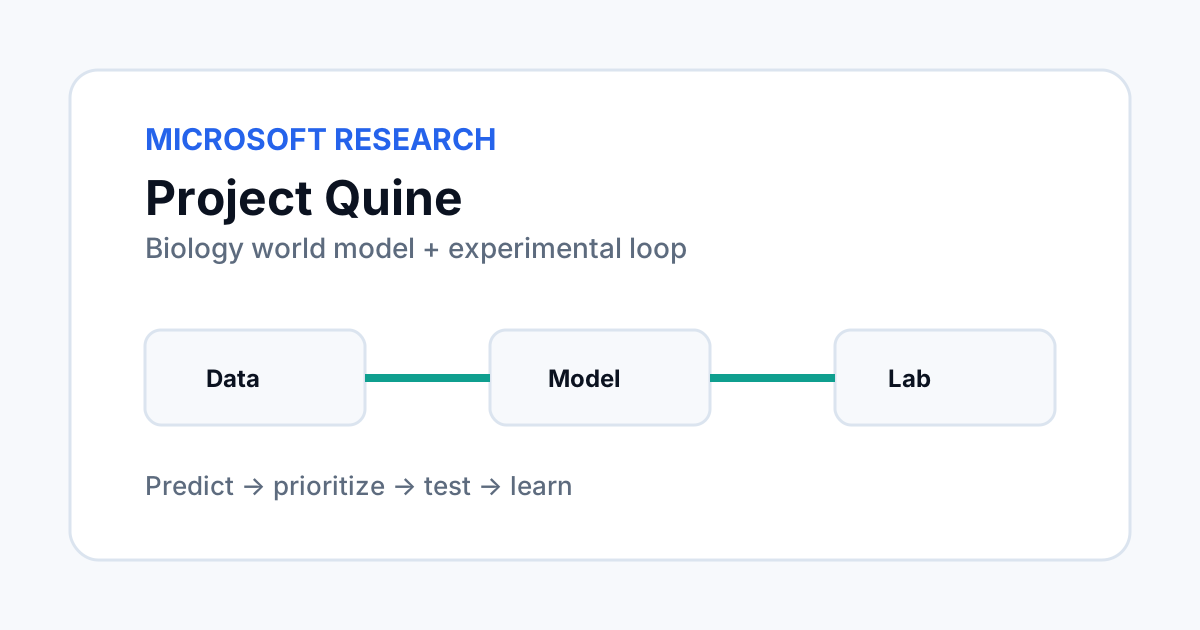
Microsoft Research introduced Project Quine on September 29, 2026, as an experimental AI research system for biology. Quine combines a multimodal biology world model with an interactive harness that connects models to scientific tools, literature, experiments and researchers. Microsoft says the goal is to help scientists explore and prioritize hypotheses before spending scarce laboratory time on them.
What Project Quine is
Microsoft describes a “world model” as a system that can represent the state of a biological system, predict how it may change after an intervention, and reason about consequences several steps into the future. Quine is the company's first step toward that idea.
The system works across biological modalities including sequence, structure, function, cellular state and imaging. Microsoft says joint training across these modalities lets evidence from one level inform predictions at another instead of keeping each data type inside a separate specialist model.
The scientist stays inside the loop
Quine is not presented as a replacement for laboratory science. Microsoft's architecture starts with a scientist's question, produces candidate proposals, prioritizes designs for experiments, and then feeds experimental measurements back into the process.
That creates a useful model for AI-assisted research: computation handles more of the search and prioritization, while humans decide which hypotheses are worth testing and interpret the experimental evidence.
How the multimodal model works
| Biology layer | Example evidence | Why it matters |
|---|---|---|
| Sequence | DNA and RNA information | Encodes biological instructions. |
| Structure | Protein or molecular structure | Helps explain physical interactions. |
| Function | Observed biological activity | Connects representation to behavior. |
| Cellular state | Cell-state measurements | Shows how cells change under conditions. |
| Imaging | Microscopy and related data | Provides visual evidence at larger scales. |
The value is in the links between these layers. A prediction based on one data type can be checked against a different type before researchers commit to an experiment.
The pancreatic cancer example
Microsoft says Quine was used with researchers at the Broad Institute of MIT and Harvard to study pancreatic ductal adenocarcinoma. The research explored whether non-genetic features of cancer, especially cellular state, could be used to identify actionable therapeutic directions.
The team used Quine to predict and prioritize thousands of compounds that might shift tumor cells between relevant states. Microsoft says the highest-ranked compounds produced the intended shifts in wet-lab assays and that the computational narrowing from a large search space to a small set of candidates took one weekend.
The experiments also exposed a third cellular phenotype that the researchers had not expected from the simpler classical-to-basal picture. Microsoft says that observation fed new hypotheses back into the system.
Why the feedback loop matters
The interesting part of Quine is not only its model architecture. It is the loop connecting prediction to measurement. If the experiment disagrees with the prediction, that disagreement becomes useful information. If a surprising outcome is reproducible, it can change the next research question.
This is the same basic pattern that makes strong AI agents useful in other domains: explicit state, multiple tools, verification, feedback and a human owner for important decisions.
Access is deliberately limited
Microsoft says Quine is experimental research technology for research rather than clinical or medical use. Its outputs can be incomplete or inaccurate and require qualified review and experimental validation. Initial access is limited to the Quine Fellows program and selected research collaborations.
That limitation is important. A research system that can prioritize experiments is not the same thing as an approved clinical product. Teams should keep model output separate from medical decisions unless the system has gone through the required validation and governance for that setting.
What AI research teams can learn
- Keep a human owner for the research question.
- Use AI to narrow large search spaces before expensive experiments.
- Represent evidence across multiple modalities when the problem is naturally multiscale.
- Feed experimental results back into the next research cycle.
- Record uncertainty and failure, not just successful predictions.
Frequently asked questions
Is Microsoft Quine a medical product?
No. Microsoft describes Quine as experimental research technology intended for research, not clinical or medical use.
What data types does Quine work with?
Microsoft says its world model learns shared representations across sequence, structure, function, cellular state and imaging data, spanning areas such as genomics, proteins, chemistry, RNA and bioimaging.
Has Quine been tested in the lab?
Yes. Microsoft reports wet-lab validation of top-ranked compounds in pancreatic cancer research conducted with collaborators at the Broad Institute of MIT and Harvard.