OpenAI introduced GPT-6.1 Sol on September 29, 2026, as a new step above GPT-6 Sol for developers and work-focused users. The release is useful to understand as a workflow change, not just a new model number: OpenAI says the model improves complex professional work, coding and computer use while keeping API pricing at $2 per million input tokens and $10 per million output tokens.
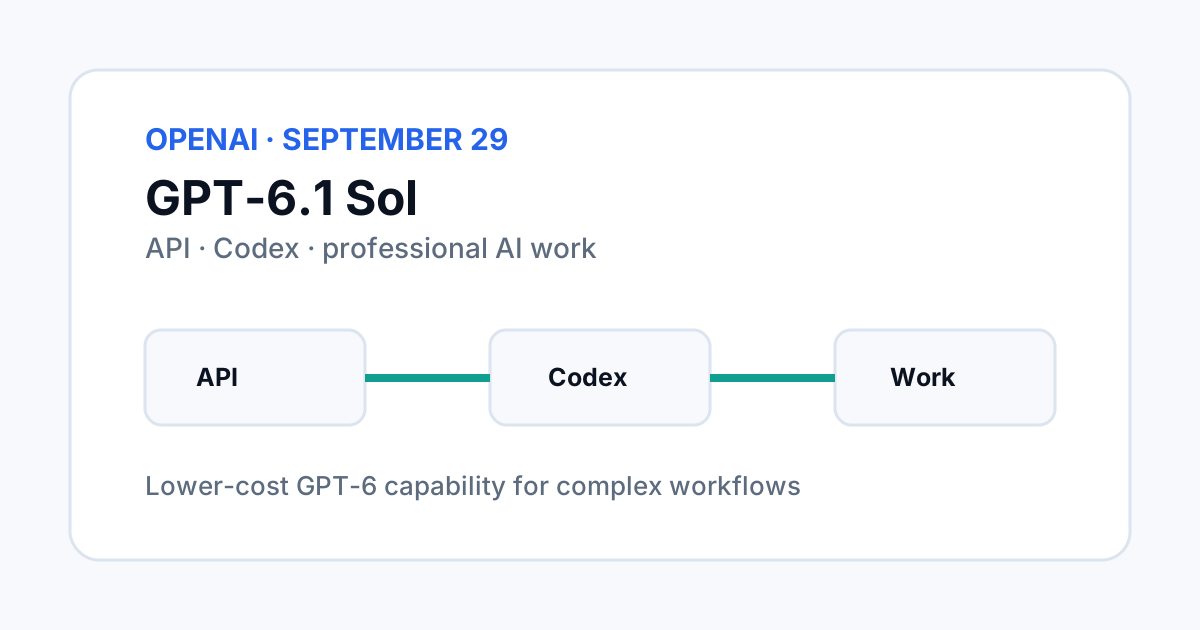
What GPT-6.1 Sol is
GPT-6.1 Sol is an updated member of the GPT-6 family. OpenAI's September 29 update says it is designed to bring more of the capability behind the higher-end Astra model into a lower-cost model tier. It is aimed at tasks such as professional work, coding, computer use and long-running agent workflows.
The model is available through the OpenAI API as gpt-6.1-sol. OpenAI also says it is available in ChatGPT Work and Codex for Plus, Pro, Business, Enterprise and Edu users, while regular Chat is a separate availability path.
What changed from GPT-6 Sol
The useful comparison is not the model name alone. OpenAI describes improvements over GPT-6 Sol in complex work, coding, computer use and factual reliability. The company also positions the model as a more capable choice when teams need to iterate on difficult work without using the highest-cost model for every step.
OpenAI's public update places GPT-6.1 Sol alongside the existing GPT-6 Sol and GPT-6 Luna models. That makes the family more useful as a tiered system: teams can match capability and cost to the actual job instead of treating every task as an all-or-nothing model choice.
API pricing and caching
| Model | Input / 1M tokens | Cached input / 1M | Output / 1M |
|---|---|---|---|
| GPT-6.1 Sol | $2 | $0.10 | $10 |
| GPT-6 Sol | $2 | $0.10 | $10 |
The practical point is that GPT-6.1 Sol is not being sold mainly by cutting the already-low list price. The value OpenAI is describing is more capability at the same basic Sol price point. Developers should still measure total task cost because reasoning effort, context size, tool calls and output length can change the final bill.
OpenAI also says GPT-6 prompt caching now provides higher cache hit rates by default, with a 90% discount on cached input reads for eligible usage. That matters most for agents and long conversations that reuse large context windows.
What developers should actually test
- Representative coding tasks. Use real anonymized repositories, not toy prompts.
- Long-context work. Test whether repeated instructions and reference material stay useful across multiple steps.
- Tool use. Measure failures, retries and unnecessary tool calls, not just answer quality.
- Computer workflows. Test navigation, recovery and permission handling in the same environment your agent will use.
- Human correction. Record how much review is needed before output can ship.
Why model selection should happen at the workflow level
A model can look excellent on a benchmark and still be a poor fit for a company's actual process. A coding workflow may depend on repository conventions. A research task may depend on citations and source handling. A computer-use task may depend on tool latency and permission boundaries.
That means the right unit of measurement is often a completed task. Track time to verified completion, correction time, tool calls and total usage cost. Those numbers tell you more about operational fit than a single benchmark percentage.
How this affects SEO and content teams
For SEO teams, GPT-6.1 Sol can be tested on multi-step jobs such as content briefs from search data, technical audit triage, structured research, internal-link planning and report generation. The useful test is whether the model can move from evidence to a clean deliverable without creating extra review work.
Keep SEO research and publication controls outside the model. The agent can draft or analyze, while source checks, approvals, repository changes and deployment remain explicit steps in the workflow.
Availability and limitations
OpenAI says GPT-6.1 Sol is available in the API and in ChatGPT Work and Codex for specified paid and education plans, while it is not yet available in regular Chat. Availability can also roll out gradually, so an account may not see it immediately.
OpenAI's benchmark results are company-reported and compare different models under different evaluation setups. Use them as reference points, not as a guarantee for a specific production workload.
Frequently asked questions
What is GPT-6.1 Sol?
GPT-6.1 Sol is OpenAI's September 29, 2026 update to the Sol tier of the GPT-6 family, aimed at stronger professional, coding and computer-use work at a lower-cost model tier.
How much does GPT-6.1 Sol cost?
OpenAI lists $2 per million input tokens, $0.10 per million cached input tokens and $10 per million output tokens.
Is GPT-6.1 Sol available in regular ChatGPT chat?
OpenAI says GPT-6.1 Sol is available in ChatGPT Work and Codex for supported plans and in the API. It is not yet available in regular Chat.
Sources
- OpenAI — Introducing GPT-6 Sol and Luna
- OpenAI — Better prompt caching for GPT-6
- OpenAI — Introducing GPT-6.1 Sol