OpenAI introduced the Agents API in public beta on September 10, 2026. The service packages a managed agent harness around the Codex approach, so developers can build agents that keep context, use tools, work with files and delegate tasks to subagents. The practical question is not only what the API can do, but how to design a reliable workflow around it.
What the Agents API is
OpenAI describes the Agents API as a public-beta way to build and run cloud agents with the Codex harness. The platform handles the agent runtime while developers choose the model, instructions, tools, knowledge and environment that fit the workload. OpenAI says agents can work across long sessions and coordinate subagents.
Why the harness matters
A model alone is not a production agent. A useful agent needs state, tool access, controlled execution, clear failure handling and a way to preserve evidence. The Agents API is aimed at this layer. That makes the harness an important design concern for teams that are moving from one-off prompts to multi-step work.
Choose the execution environment
OpenAI lists several environment options, including OpenAI-hosted sandboxes and partner environments. The right choice depends on where files, packages, secrets and other resources must live. Keep the environment as narrow as the task requires. An agent that only needs to inspect a repository should not automatically get broad access to unrelated systems.
| Workload | Useful control |
|---|---|
| Research | Read-only files and source links |
| Code changes | Sandboxed workspace and review gate |
| Operations | Explicit tool permissions and logs |
| Long tasks | Saved state, outputs and checkpoints |
Use subagents for narrow jobs
Subagents are useful when a task can be split into separate checks. For example, one worker can inspect logs, another can review dependencies and another can compare configuration. Keep each role narrow and define what evidence the subagent must return. A collection of loosely defined subagents can create more noise than useful parallel work.
Design the approval boundary
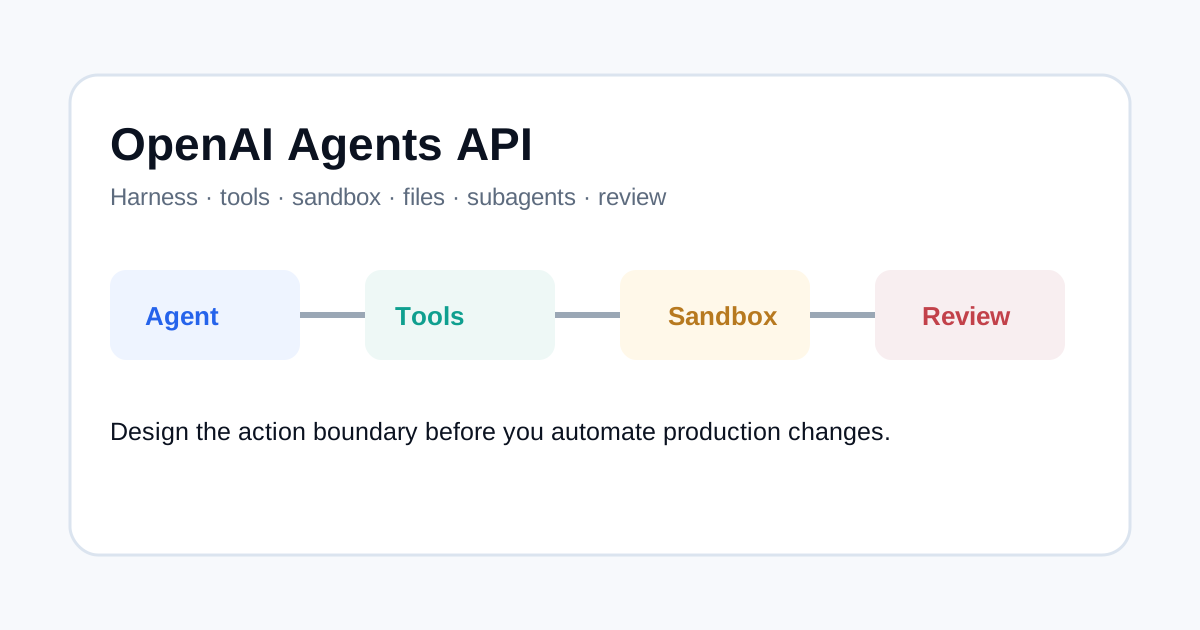
Production agents should separate analysis from actions that change external state. Reading files, generating a report and calculating a result are different from publishing code, sending a message or changing infrastructure. Use explicit approval steps for high-impact actions, and make the final action traceable to the evidence that justified it.
How SEO and marketing teams can use it
Teams can use agent workflows for repetitive research, crawl-data analysis, content QA, reporting and technical checks. A useful pattern is to give the agent structured inputs, require a saved evidence file, and make a human review the final recommendation before any production change. ToolBoxKart’s AI agent evaluation workflow and AI agent approval policy guide provide useful related context.
Limits to keep in mind
The Agents API is in public beta, so behavior, interfaces and integrations can change. OpenAI says there are no additional Agents API fees beyond the tokens and tools used, while the exact cost of an application still depends on its model and tool usage. Treat public-beta behavior as something to test before building a critical workflow around it.
Frequently asked questions
Is the Agents API the same thing as a model?
No. It is an agent runtime and harness around model-driven workflows, including tools, context and execution environments.
Can an agent run without human review?
It can be designed to act autonomously, but teams should set approval boundaries around actions that can change external systems or create material risk.