Gnani Artha and Evon v3.3: What the Launch Means
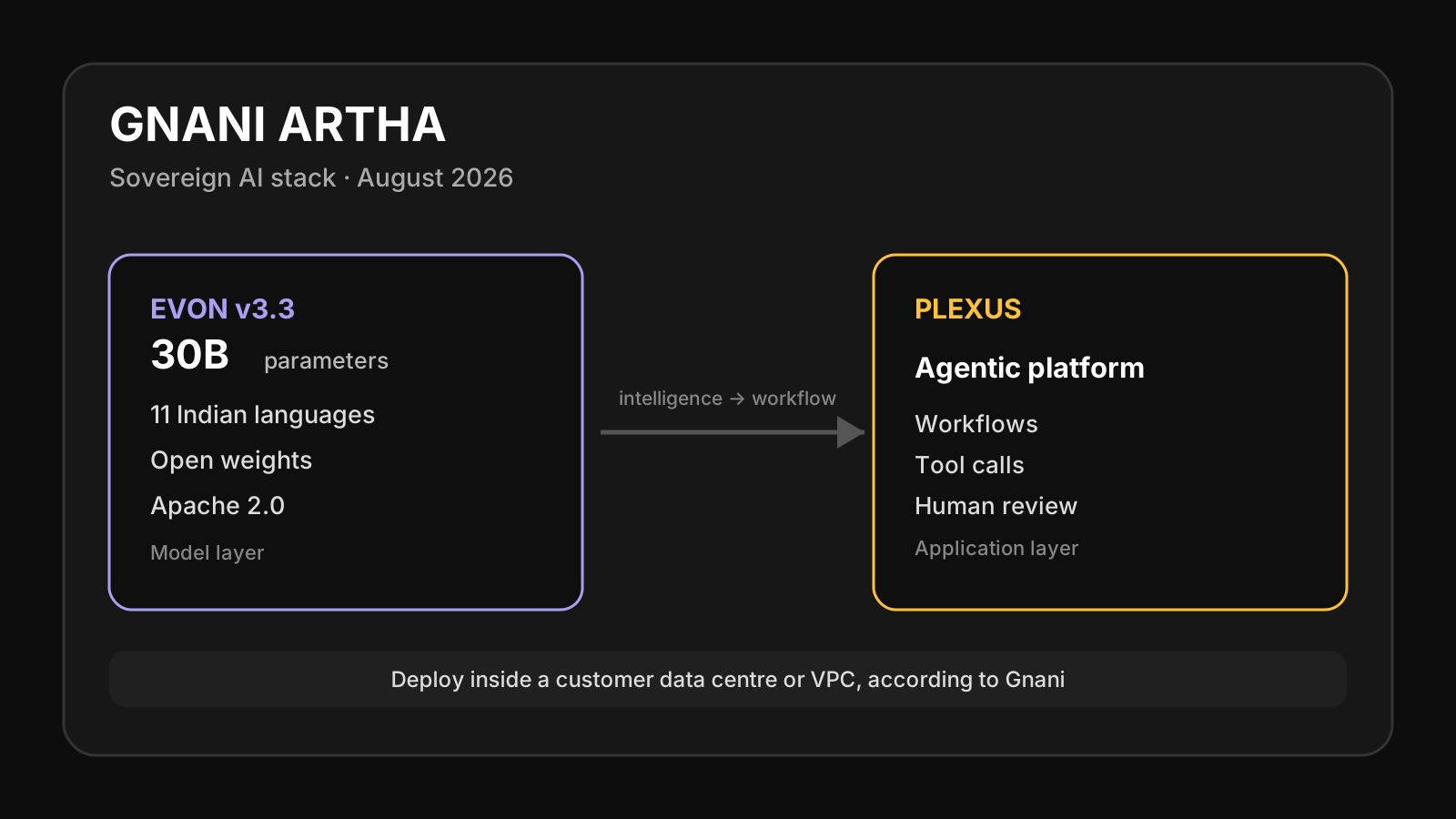
Gnani AI launched its Artha sovereign AI stack in New Delhi. The launch took place on August 28, 2026. The stack combines Evon v3.3, an open-weights language model, with Plexus, an agentic AI platform.
The useful story sits beyond the launch event. Gnani ties model weights, Indian-language training, token efficiency, and self-hosted deployment into one product. Some performance claims come from Gnani's own testing. Buyers should treat them as claims until independent tests confirm them.
What did Gnani launch on August 28, 2026?
Gnani launched Artha at Uprashtrapati Bhavan in New Delhi on August 28. The Government of India confirmed the launch. It described Evon 3.3 as the language model and Plexus as the platform for real-world work.
Gnani's own Artha page gives the product a wider scope. Gnani describes Artha as an end-to-end stack with models and Plexus. It also includes infrastructure for deployment in a customer data centre or virtual private cloud.
What does “sovereign AI” mean here?
Sovereign AI refers to where an organisation controls the model, data, and deployment environment. It does not simply mean that a model was created in India or trained on Indian data.
Open weights and sovereign AI also mean different things. Open weights describe access to a model's learned parameters under a license. Sovereign deployment describes who controls the environment where the model runs and where customer data stays.
Gnani says Evon v3.3 uses Apache 2.0 licensing and can run on customer infrastructure. That setup can matter for institutions that face data residency, vendor control, or internal security requirements.
What is Evon v3.3?
Evon v3.3 is the language model at the centre of Artha. Gnani says it has 30 billion total parameters, with about 3.5 billion active parameters on each token.
Gnani also says the model was trained natively across 11 Indian languages. Gnani says its team rebuilt the tokenizer for Indian scripts. The goal is to reduce tokens needed for Indian-language text.
Why does the tokenizer matter?
A tokenizer breaks text into smaller units before a model processes it. Better tokenization can reduce tokens for the same text. That can affect compute cost and usable context.
Gnani says Evon v3.3 uses about 20% fewer tokens per Indian-language word. The comparison uses the GPT-5 family tokenizer. That is a company comparison, not an independent benchmark result.
How strong is Evon v3.3 according to the available evidence?
Gnani reports that Evon v3.3 beats a 105-billion-parameter Indic model on 10 of 11 languages in the MILU benchmark. It also says the model matches a similar-size hosted global frontier model across the same benchmark set.
These are useful claims, but the source matters. Gnani presents the results on its own product page. News coverage reports additional company testing across roughly 40 to 45 benchmarks.
What should buyers ask before trusting those numbers?
Ask for the exact benchmark versions, prompts, scoring rules, model settings, and comparison models. Also ask whether the test uses public benchmark data that may appear in training sets.
Parameter count alone does not decide model quality. Real deployment results depend on language coverage, latency, hardware, retrieval, tool use, safety controls, and the workload itself.
What does Plexus add to Artha?
Plexus turns the model layer into an agent platform. Gnani describes it as an orchestration system for trigger-based workflows, tool calls, integrations, governance, and human review.
This matters because a language model alone does not complete an enterprise process. A useful enterprise system also needs identity, permissions, and audit logs. It also needs data access and clear points for human control.
Why could Artha matter for Indian enterprises?
The strongest case is control over deployment and Indian-language processing. An organisation can keep data inside infrastructure it controls.
For teams that manage article metadata, the Article Schema Generator can help produce the JSON-LD used on content pages. A Canonical Checker can also verify the preferred URL before publication.
Indian-language efficiency could also matter at high volume. Gnani says Artha targets banks, insurers, healthcare firms, telecom firms, and public institutions. Its use cases cover documents, compliance, service, and workflow automation.
That does not prove adoption or production success. Gnani's own page labels several use cases as illustrative and says they do not describe specific existing deployments.
What are the main trade-offs with a sovereign AI stack?
Self-hosting gives an organisation more control, but it also shifts more operational work to the buyer. Teams may need to manage hardware, model updates, monitoring, security, scaling, and integration.
Open weights also do not remove model risk. Organisations still need evaluation, access controls, data governance, prompt defense, and testing against their own workloads.
What should AI and SEO teams take from this launch?
The SEO lesson is indirect but useful. More organisations may deploy private models. Content teams may then write for different retrieval environments.
Clear facts, consistent entity information, strong internal links, and structured pages still help machines interpret content. The same technical discipline behind a good technical SEO checklist can support better machine-readable content.
Teams that study AI visibility should also separate model selection from search visibility. A self-hosted model can change how an organisation retrieves and summarizes its own content. Google AI Search can surface public web content through another system. The two problems need different measurements.
For site owners tracking Google Search changes, the recent AI Overviews auto-expand test shows why that distinction matters. Search interface changes affect visibility even when the underlying website stays the same.
What should developers verify before evaluating Evon v3.3?
Start with access terms, model weights, hardware needs, context limits, supported languages, inference software, and the actual license. Then test a small workload with the same prompts and data used in your current system.
Benchmark the tasks that matter to you. For an Indian-language support system, measure accuracy and token use in the languages your users actually speak. For an agent workflow, measure tool-call success, failure recovery, latency, and human review rates.
Do not choose the model only because its parameter count looks competitive. Total cost and operational fit matter more than a single benchmark.
Gnani Artha and Evon v3.3 FAQ
When did Gnani Artha launch?
Gnani Artha launched in New Delhi on August 28, 2026. The launch took place at Uprashtrapati Bhavan and was confirmed by the Government of India.
Is Evon v3.3 an open-source model?
Gnani describes Evon v3.3 as an open-weights model and lists an Apache 2.0 license. Open weights are not the same thing as open-source software across the entire stack.
How many parameters does Evon v3.3 have?
Gnani lists 30 billion total parameters and about 3.5 billion active parameters per token. These figures come from the company's product information.
Does sovereign AI mean data never leaves a country?
Not automatically. Sovereignty depends on the deployment architecture, contracts, infrastructure, access controls, and where data is processed and stored.
Are Evon v3.3 benchmark claims independently verified?
Not in the primary sources reviewed for this article. Gnani reports its benchmark results, so buyers should request reproducible test details and run their own evaluation.
Sources
Related on Tool Box Kart: Tencent Hy4 Preview and Canonical Checker.