Accenture Federal Services and Google Public Sector announced Gemini Launchpads on October 19, 2026. The idea is to help US federal agencies move from small AI-agent experiments to systems connected to real mission workflows. Rather than offering only a model or a software license, the program combines Gemini, secure cloud infrastructure, embedded engineers and agency subject-matter experts to identify use cases, connect data, build agents and train staff.
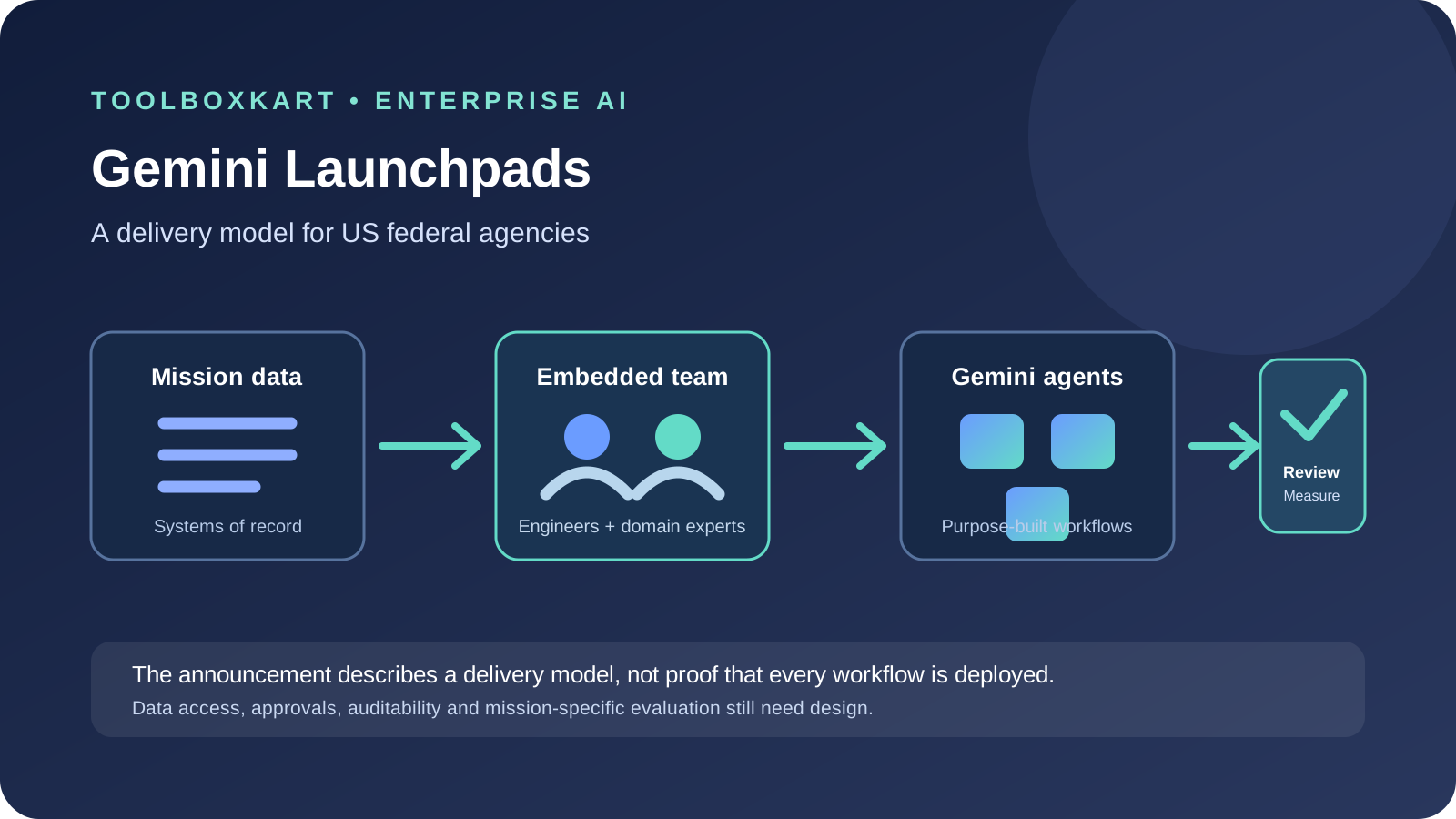
What a Gemini Launchpad is meant to do
The announcement describes a centralized way for an agency to manage agent projects. Teams would connect Gemini to approved mission datasets, prioritize candidate workflows, build and deploy purpose-specific agents, and train employees to use them. The partners say leadership would also get a view of performance and mission impact.
The first set of pre-built agents is being developed for common functions such as human resources, finance and supply chain. These are described as work in progress, not as a public catalogue of fully deployed agents available to every agency today. Agencies are invited to explore the capabilities through collaborative workshops at The Forge in Washington, DC.
Why embedded engineering is part of the offer
Government workflows rarely fit a generic assistant without changes. A useful agent may need access to an agency's systems of record, an understanding of local policy, strict identity controls and a clear path for a person to review or reverse its actions. The Launchpads model places forward-deployed engineers alongside agency teams to help connect those pieces.
Accenture says it is training an initial cohort of Google Cloud-skilled forward-deployed engineers as part of a broader commitment to establish a 1,000-person workforce for its Gemini Enterprise business group. The announcement does not say how many federal agencies have completed deployments, publish independent performance results or disclose pricing for individual engagements.
Which workflows are plausible starting points?
The named HR, finance and supply-chain areas contain repeatable tasks that may be suitable for bounded agent assistance. A team should still define the exact workflow before choosing a model. Examples of potential starting points include:
- HR: find policy documents, summarize approved guidance and prepare a draft response for an HR specialist to review.
- Finance: gather supporting records for a reconciliation or explain a discrepancy without approving a payment automatically.
- Supply chain: assemble supplier status and contract details, flag missing information and prepare a recommendation for an authorized buyer.
These are illustrative use cases, not confirmed examples of agents already delivered through Launchpads. In sensitive workflows, the first release should retrieve and prepare information rather than make irreversible decisions.
Questions agencies should settle before connecting data
A workshop can identify a promising use case, but it cannot replace security, legal and operational approval. Before a pilot reaches production, the agency should document:
- Data boundaries: which records the agent may read, whether the data contains controlled or classified information, and which systems are excluded.
- Identity and permissions: whether the agent acts as a user, a service identity or a delegated role, and how least privilege is enforced.
- Action limits: which steps are read-only, which can create drafts, and which require a named human approver.
- Audit trail: what prompts, retrieved sources, tool calls, approvals, outputs and failures are logged, with appropriate retention controls.
- Evaluation: how accuracy, task completion, unauthorized access, latency and exception handling will be tested before rollout.
- Exit plan: how the agency can disable the agent, revoke credentials, export records and revert to the existing process.
These controls are especially important when agents can call tools or update records. ToolBoxKart's guides to human approval gates for agent workflows and testing MCP server permissions provide practical starting points for those reviews.
What the announcement does not yet answer
The joint announcement does not provide a public price list, a complete technical architecture, agency-by-agency availability, accreditation details for every data class, or independent outcome measurements. It also does not specify which government systems are already connected or what service-level commitments apply. Agencies should request those details directly and assess them against their own procurement and security requirements.
The useful signal is the delivery approach: the partners are pairing a model platform with domain expertise and embedded engineering. Whether that approach produces reliable public-service outcomes will depend on the individual use case, the quality of data connections, operational ownership and the strength of approval and monitoring controls.
Sources
- Accenture Federal Services: Gemini Launchpads announcement
- Google Cloud: Gemini agent and enterprise controls
- Google: Gemini agent overview