Google’s new AI & Economy ATLAS material is useful for a problem that comes up often in Gemini workflows: turning broad AI claims into evidence that can be checked. The new data and research give teams a better starting point for questions about how AI is being used in science, work and the economy.
What the ATLAS update adds
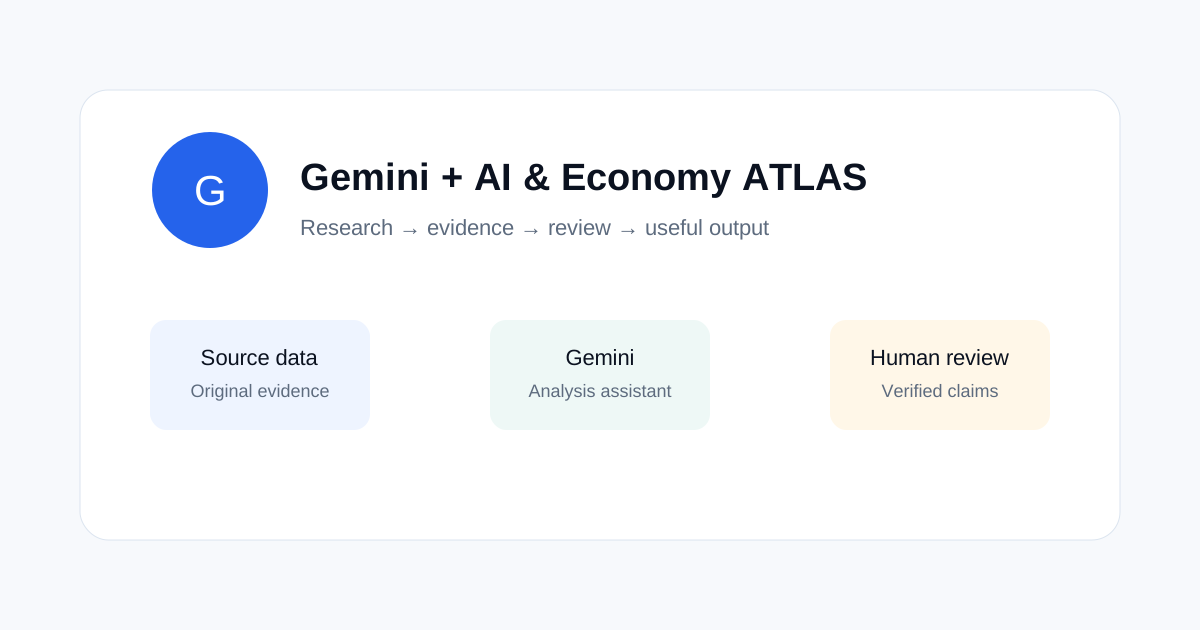
Google says its updated ATLAS experience includes new data visualizations and research about how scientists are using AI. The practical value is not the dashboard alone. It is the ability to inspect a claim, find the underlying evidence and then use Gemini to organize the information without treating the model as the source.
Use Gemini as the research layer
A useful workflow is to keep the evidence outside the model and use Gemini for comparison, summarization and question generation. Give the model the source material or a clearly identified source list, then ask it to separate measured findings from interpretation.
- Start with the original ATLAS dataset or research page.
- Write down the exact question you need to answer.
- Use Gemini to identify relevant findings and gaps.
- Open the underlying source for every important claim.
- Save the final evidence with the date and source URL.
Where SEO teams can use this
SEO teams can use research data to build stronger briefs, find questions worth answering and challenge weak industry assumptions. A good brief should show which facts came from research and which conclusions are your own.
That is especially important for AI-search content. A model can produce a clean summary, but search visibility depends on the quality and usefulness of the published page, not on the fact that Gemini helped write it.
Do not turn a data dashboard into a ranking signal
ATLAS can support research, but it does not become a Google ranking factor just because Google published it. Keep product research, search guidance and ranking claims separate.
A simple evidence table
| Step | Check |
|---|---|
| Source | Is the claim tied to an original source? |
| Measure | Is it a reported number or an interpretation? |
| Context | Does the time period and population match your use? |
| Output | Can a reader verify the statement? |
Related ToolBoxKart guides
For earlier Gemini workflow context, read the Gemini Windows app workflow guide, the Gemini 3.8 Flash API guide, the Gemini Gem SEO guide, and the Claude vs ChatGPT vs Gemini comparison.
Frequently asked questions
Is Gemini the source of the ATLAS data?
No. Treat the underlying Google research and data as the source and Gemini as an analysis assistant.
Can this replace manual source checking?
No. Important claims should be checked against the original evidence.