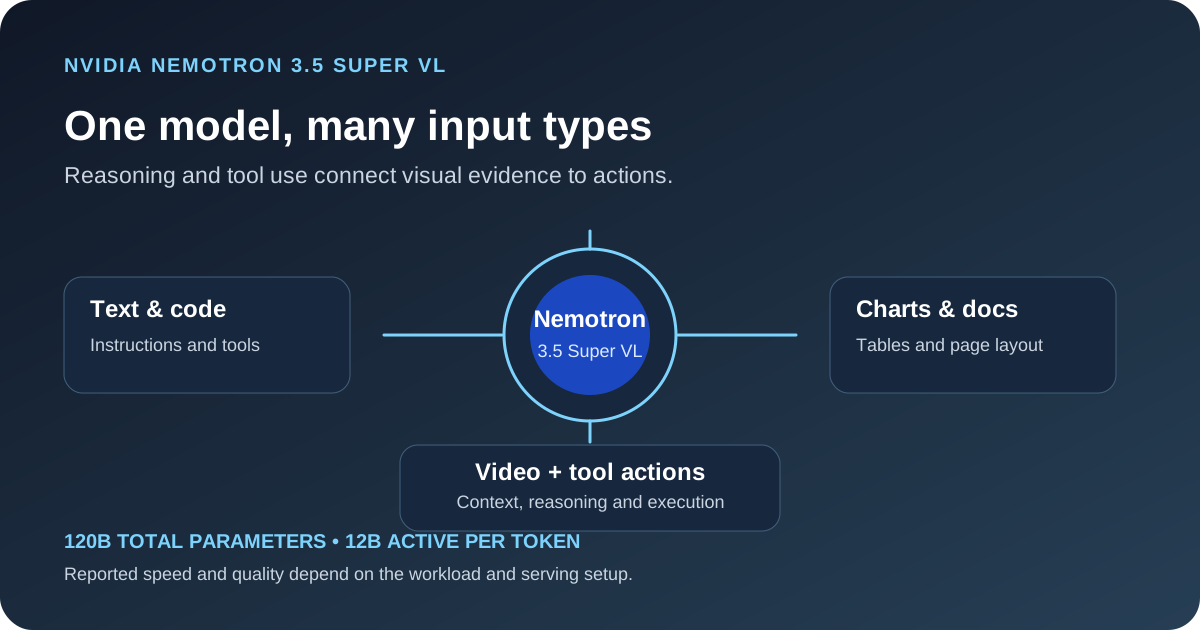
NVIDIA published details of Nemotron 3.5 Super VL on October 15, 2026. The open, customizable multimodal model combines reasoning and tool use with text, image, document and video understanding. NVIDIA describes a 120-billion-parameter mixture-of-experts architecture that activates 12 billion parameters per token, plus training and inference changes aimed at specialized enterprise agents.
What the model is designed to handle
Nemotron 3.5 Super VL is aimed at tasks that combine visual evidence, reasoning and actions. Examples include extracting data from tables and charts, researching across websites, checking code, triaging security findings and understanding video. A workflow can pass text and visual context to one model instead of splitting the task across separate language and vision models.
The architecture uses a mixture-of-experts design. NVIDIA says the model has 120 billion total parameters and activates 12 billion per token. Active parameters describe the portion used for a token's computation; they do not mean the full model's storage, memory and deployment requirements are equivalent to a 12-billion-parameter dense model. Hardware, quantization, context length, batch size and serving software still affect the resources required.
Read the performance claims with their setup
NVIDIA reports up to five times higher throughput for agentic tasks than other open models in its size category. The company also describes more than 600 output tokens per second on an Artificial Analysis Intelligence Index agentic workload running on a Baseten endpoint. These are reported results for a specific evaluation and serving setup, not a guarantee for every prompt, GPU or application.
The blog compares Nemotron 3.5 Super VL with Nemotron 3 Ultra on two agent evaluations. NVIDIA reports a score of 63.44 versus 56.33 on Hermes Bench and 87.05 versus 84.3 on LangChain behavioral evaluations. Different benchmarks measure different behavior, so do not combine them into a single universal quality score or assume that the results predict performance on a company's own documents.
NVIDIA also describes partner-specific outcomes. Scale AI reports a workload where post-training is expected to reduce inference cost by 40 times and latency by five times. Ramp expects up to 50% higher throughput and ten times lower latency for receipt processing, while AI21 and Alice report a 41% accuracy improvement for threat-intelligence work. These figures are company-reported results for those specialized workflows; they are not independent guarantees for a new deployment.
Customization is part of the release
NVIDIA says developers can post-train the model with their own data, tools, policies and workflows using the NeMo ecosystem. Supervised fine-tuning can teach domain-specific patterns, low-rank adaptation can reduce the cost of adapting model weights, and reinforcement learning can optimize behavior in environments that reflect the target workflow.
The release also includes open datasets for agentic tool use, finance reasoning, instruction following, long-context tasks, fairness and vision-language work. Teams can use these datasets as starting points, but should still check licensing, data provenance and whether the examples represent their real users and failure cases.
Inference changes target long-running agents
The model combines several serving techniques. NVIDIA describes LiLiCorr speculative decoding, NVFP4 quantization with quantization-aware distillation, multi-token prediction and context reuse. These techniques target different costs: speculative decoding attempts to generate tokens with less sequential work, lower precision reduces the size and cost of weight operations, and context reuse avoids recomputing repeated instructions and tool definitions across agent turns.
Those optimizations do not remove the need to measure end-to-end performance. A faster token generator may not improve a workflow dominated by retrieval, external tools or slow validation. Measure the full task, including time to first token, total completion time, tool calls, retries, memory use, accuracy and cost per successful result.
How to evaluate it for your workload
- Build a representative test set. Include real document layouts, charts, long inputs, tool failures, ambiguous requests and cases where the model should abstain.
- Keep the comparison fair. Use the same prompts, context, tool permissions, evaluation rubric and concurrency for each candidate. Record model version, quantization, hardware and serving stack.
- Check evidence extraction. For documents and charts, verify that the answer points to the correct page, row, cell or visual evidence. A fluent summary is not enough.
- Measure task success. Track correct final outcomes, not only token speed or intermediate tool-call success. Include failure recovery and output validation.
- Estimate deployment cost. Account for model weights, KV cache, context length, concurrency, storage, GPU time and the serving stack. Our local LLM memory guide explains the main memory components.
For agent systems with long histories, also review the context-window budgeting workflow. Before switching a production model, use the repeatable test approach in our AI model evaluation guide.
What remains workload-dependent
The announcement does not establish that Nemotron 3.5 Super VL is the best choice for every multimodal agent. Results depend on the task, model customization, inference hardware, tool environment and the cost of failures. Open weights give teams more deployment options, but they still need to check license terms, model requirements, security updates and operating costs.
For teams whose work requires reading documents, understanding visual evidence and using tools, the model is worth adding to an evaluation shortlist. The decision should come from measured task quality and total cost on the actual workflow, not from one throughput number.