Perplexity Portable Computer: What Local-First AI Really Means

Perplexity launched Portable Computer on August 25, 2026, with NVIDIA. It brings the company’s Computer agent to local NVIDIA hardware instead of making cloud servers the default runtime.
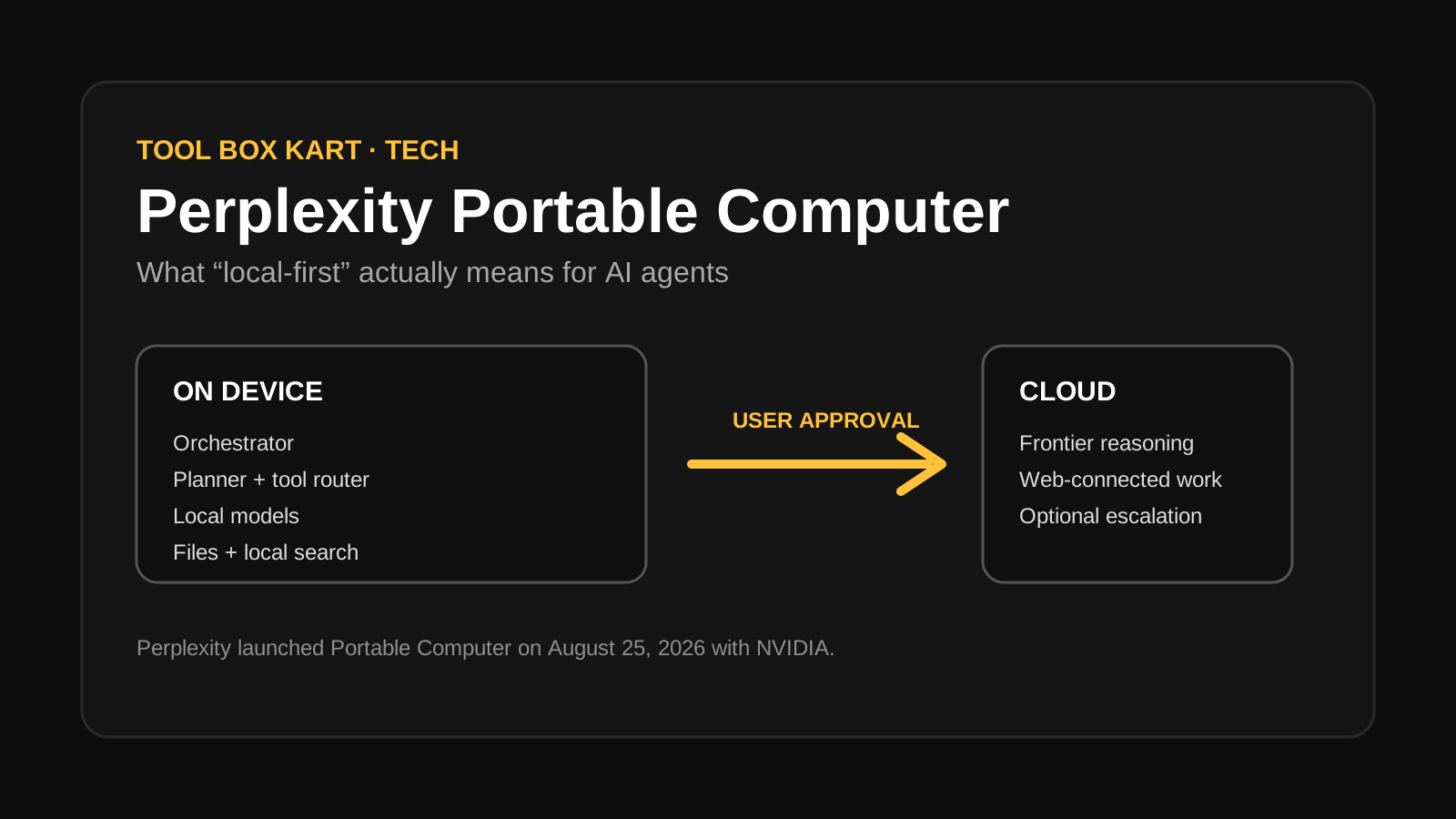
The important detail sits behind the “local-first” label. Perplexity says the orchestrator, planner, tool router, scheduler, task queue, local search index, and local models run on the device.
What did Perplexity launch?
Perplexity launched a local version of its Computer agent on August 25. The launch starts with NVIDIA DGX Spark hardware, with wider NVIDIA RTX PC support planned next.
Perplexity designed the product for work with private files, local data, and repeated agent tasks. It says local work does not consume Perplexity credits.
What does local-first mean here?
“Local-first” means the product starts the task on your hardware instead of sending every step to a cloud model. It does not mean the product can never contact a cloud service.
That distinction matters because Perplexity also supports cloud escalation. The local system can ask for permission before a step goes to a frontier model.
What actually stays on the device?
Perplexity says the core agent runtime stays on the local machine. That includes the orchestrator, planner, tool router, scheduler, durable task queue, and local search index.
The launch hardware can run Qwen 3.8 27B or PPLX 27B. PPLX 27B is a Perplexity post-trained version of Qwen, according to the company.
This setup also changes how the agent handles local knowledge work. Files can be analyzed on the device, while local search can work across those files without sending the full dataset to a cloud model.
Useful Tool Box Kart tools for this workflow
When you test AI workflows, you can also use our Structured Data Graph Viewer to inspect structured data and our Internal Link Opportunity Mapper to review internal linking opportunities on AI-focused content.
When does Portable Computer use the cloud?
Portable Computer can use cloud models when a task needs stronger reasoning or access to information outside the local environment. Perplexity says the local orchestrator asks for approval before routing that step to the cloud.
This makes the product different from a simple offline chatbot. The local machine handles the default workflow, but the system keeps a path to stronger remote models when needed.
Perplexity also says sensitive documents stay on the device during this process. That claim describes the product design, so teams should still test their own data flow before using it for regulated or highly sensitive work.
Who benefits from this setup?
Portable Computer fits teams that work with private documents and want more control over where data is processed. It also fits workloads that repeat often enough to make local inference useful.
The current hardware requirement limits access. Perplexity launches the product on NVIDIA DGX Spark first, so this is not a drop-in local AI option for every laptop.
What are the main trade-offs?
The biggest trade-off is hardware. Local inference shifts some cost from ongoing cloud usage to owned compute, so the economics depend on hardware price, utilization, maintenance, and task volume.
There is also a capability trade-off. Smaller local models can handle many tasks, but some jobs still benefit from stronger cloud reasoning.
The third trade-off is product scope. A local agent works well for private files, but web research and fresh external data still create reasons to use connected services.
What does this mean for AI search and SEO?
The launch gives SEO teams another example of why AI search is moving beyond one cloud model. AI systems now combine local models, remote models, tools, connectors, and private data in the same workflow.
For content teams, the practical lesson is simple. Pages should make facts, entities, relationships, and evidence easy for different AI systems to understand.
That does not mean adding more AI keywords. It means building clear source pages, consistent internal links, useful structured data, and original information that agents can verify.
Our Structured Data Graph Viewer can help you inspect the entity relationships exposed by your structured data. For broader site cleanup, the Internal Link Opportunity Mapper can surface pages that need stronger contextual links.
Perplexity Portable Computer FAQ
What is Perplexity Portable Computer?
It is a local version of Perplexity Computer that runs its main agent stack on NVIDIA hardware.
Does Portable Computer work fully offline?
Not as a general rule. The core workflow can run locally, but the product can request cloud help for tasks that need stronger reasoning or external information.
Which local models does Portable Computer use?
Perplexity says the launch supports Qwen 3.8 27B and PPLX 27B. NVIDIA Nemotron 3.5 Lightning is planned for the model picker.
Who can use Portable Computer?
Perplexity launched it for Pro and Max subscribers with NVIDIA DGX Spark hardware. Wider NVIDIA RTX PC support is planned.
Written by Deepak Parmar
Deepak Parmar is an SEO and AI-search specialist focused on technical SEO, content strategy, and search visibility.
He writes practical guides on Google Search, AI Search, AI tools, technology, and digital workflows.
Sources
Related on Tool Box Kart: Tencent Hy4 Preview Explained and Structured Data Graph Viewer.